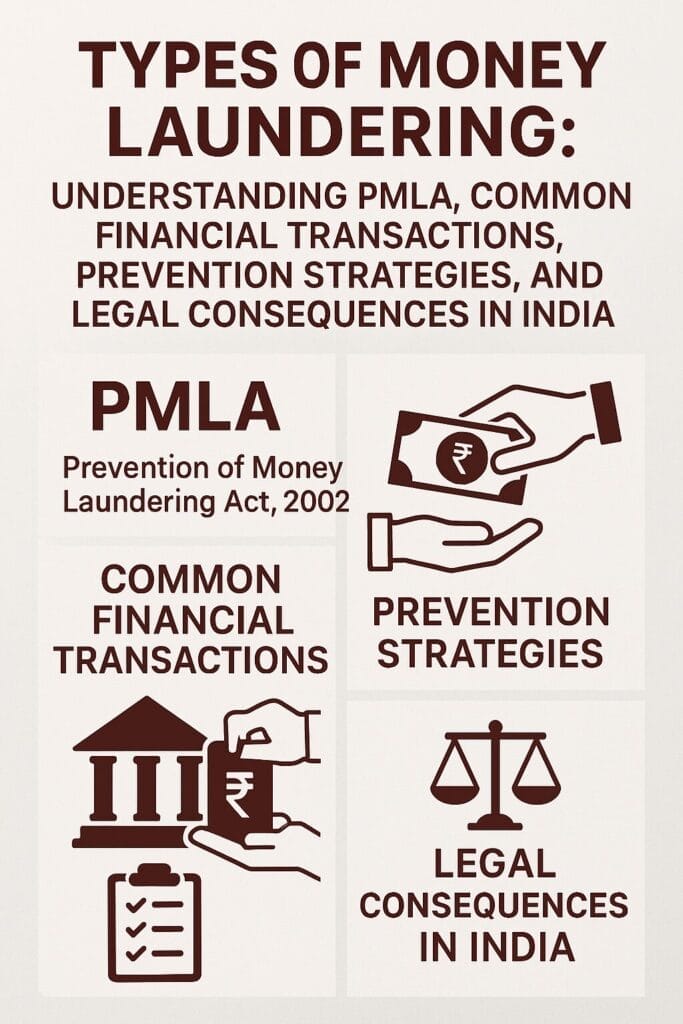
Types of Money Laundering: Understanding PMLA, Common Financial Transactions, Prevention Strategies, and Legal Consequences in India

Key Takeaways
- Under the PMLA, financial institutions must report suspicious transactions by filing a Suspicious Transaction Report (STR) with the FIU-IND and maintain all transaction records for a minimum of five years.
- PMLA violations attract imprisonment of three to seven years, fines between ₹5 lakh and ₹25 crore, and authorize the Enforcement Directorate to seize and forfeit assets from money laundering.
- The Enforcement Directorate follows a statutory process under PMLA—issuing a show cause notice, conducting hearings, adjudicating liability, and permitting appeals to the PMLA Appellate Tribunal.
- Receiving a summons or notice from the Enforcement Directorate under PMLA mandates consulting legal counsel immediately to assemble documents, protect against self-incrimination, and formulate a defense strategy.
- Landmark Indian cases such as the 2G Spectrum and Punjab National Bank scams illustrate the use of shell companies, layering of transactions, and real estate acquisitions to launder illicit funds.
Money laundering is a serious issue that affects the economy and society. It’s crucial to understand the types of financial transactions involved and how they relate to the Prevention of Money Laundering Act (PMLA) in India.
In this post, I’ll break down the common transactions associated with money laundering, and how individuals and businesses can spot and stop these activities. Understanding the money laundering process is essential for anyone investing or running a business in India.
I’ll also discuss when it’s important to seek legal advice if you face allegations under the PMLA. Lastly, you’ll learn about the potential legal consequences for failing to comply with PMLA regulations.
This information is vital for protecting yourself and your interests in the financial landscape. Let’s dive in!
What Types of Financial Transactions Are Commonly Associated with Money Laundering in India Under PMLA Regulations?
In India, money laundering often involves complex financial transactions aimed at concealing the origins of illegally obtained money, primarily through the Prevention of Money Laundering Act (PMLA). The common types of transactions include cash transactions, transfers through banking systems, real estate purchases, and investments in businesses or financial instruments.
What Are Common Transaction Types Involved in Money Laundering?
Money laundering involves various transactions. These transactions typically aim to disguise illicit funds as legitimate income. Common ones include:
- Cash Transactions: Large sums of cash deposited in banks without clear sources can trigger suspicion.
- Bank Transfers: Use of wire transfers between accounts to obscure the source of funds is common.
- Real Estate Transactions: Purchasing properties at inflated prices can mask illegal funds.
- Cash Businesses: Businesses that deal mostly in cash, such as restaurants and retail shops, are often utilized.
Are There Various Phases of Money Laundering Transactions?
Yes, money laundering generally occurs in three phases: placement, layering, and integration. Each phase serves a distinct purpose.
| Phase | Description |
|---|---|
| Placement | Introducing illicit money into the financial system. |
| Layering | Concealing the source through a series of transactions. |
| Integration | Reintroducing the laundered money into the economy. |
How Do Financial Institutions Report Suspicious Transactions?
Under the PMLA, financial institutions must report suspicious transactions. The process includes:
- Identifying suspicious patterns in transactions.
- Filing a Suspicious Transaction Report (STR) to the Financial Intelligence Unit (FIU).
- Maintaining records for five years.
Are There Any Real-World Examples of Money Laundering in India?
Yes, several cases highlight money laundering activities. For instance, the infamous 2G Spectrum case involved significant amounts of money being funneled through various shell companies to conceal illicit gains. Another notable case is the Punjab National Bank scam, where fraudulent loans were hidden through complex financial maneuvers.
What Roles Do Shell Companies Play in Money Laundering?
Shell companies are crucial in laundering money. They are often created with minimal ongoing operations and are used to obscure the true ownership of funds. Here’s how they function:
- Facilitate transactions without proper scrutiny.
- Serve as fronts for legitimate activities while hiding illegal money.
- Enable cross-border transfers that complicate tracing efforts.
Need Legal Assistance?
If you suspect involvement in money laundering activities, it is crucial to consult a legal expert. Understanding the legal landscape around the PMLA can help in compliance and avoidance of penalties.
Frequently Asked Questions
What are “hawks” in money laundering?
Hawks are individuals or entities that monitor and report suspicious financial activities.
How does the government punish money laundering?
The government can impose heavy fines and imprisonment for violations under the PMLA.
What should I do if I receive a notice under the PMLA?
Seek immediate legal advice to understand your rights and obligations.
How Can Individuals and Businesses Identify and Prevent Money Laundering Activities to Comply with the PMLA?
Individuals and businesses can identify and prevent money laundering activities by understanding the signs, implementing compliance measures, and conducting regular training sessions.
What are the Key Signs of Money Laundering?
Recognizing the signs of money laundering is crucial. Some common indicators include:
– Unusual transaction patterns or large cash deposits.
– Transactions that involve multiple countries with no apparent reason.
– Clients who are unwilling to provide identification or financial details.
– A client’s or partner’s background does not match their financial transactions.
Understanding these signs helps in early detection.
How Can Businesses Implement Anti-Money Laundering (AML) Procedures?
Businesses need to establish strong AML procedures. This can include:
1. Conducting risk assessments regularly.
2. Implementing know-your-customer (KYC) practices.
3. Training staff on recognizing suspicious transactions.
4. Monitoring transactions and maintaining proper records.
Developing a robust policy will help protect the business from unintentional involvement in money laundering.
Why is Employee Training Important?
Training is essential for all employees. When staff members are well-educated about money laundering risks, they can:
– Identify red flags easily.
– Report suspicious activities confidently.
– Understand their roles in preventing money laundering.
Regular training sessions can ensure that employees remain aware of emerging trends and regulations.
How Should Record-Keeping Be Done?
Proper record-keeping plays a vital role in compliance. Important records to maintain include:
– Customer identification documents.
– Transaction details and correspondence.
– Reports of suspicious activities.
Keeping these documents organized makes it easier to comply with regulatory requests.
Can Technology Help in Preventing Money Laundering?
Yes, technology plays an important role in AML efforts. Some ways technology helps include:
– Automated systems for monitoring transactions.
– Data analysis to detect unusual patterns.
– Digital storage for maintaining records securely.
Investing in technology can significantly enhance compliance efforts.
Comparison of Common Anti-Money Laundering Measures
| Measure | Description | Importance |
|————————-|——————————————————|——————————–|
| Risk Assessment | Evaluating potential risks associated with clients | Forms the foundation of AML |
| KYC Procedures | Verifying the identity of clients | Reduces risks of fake identities|
| Staff Training | Educating employees on AML laws and practices | Essential for effective compliance|
| Automated Monitoring | Using software to track suspicious activities | Acts quickly on potential issues|
Understanding these measures helps businesses take a comprehensive approach to AML compliance.
What Is the Role of Regulatory Bodies?
In India, the Financial Intelligence Unit (FIU) serves as the primary regulatory body. The FIU monitors compliance with the Prevention of Money Laundering Act (PMLA). Key roles include:
– Collecting and analyzing information related to money laundering.
– Issuing guidelines for reporting suspicious transactions.
– Taking action against non-compliant entities.
Regular interaction with regulatory bodies ensures that businesses remain compliant.
Mini FAQ
What should I do if I suspect money laundering?
Immediately report your suspicions to the appropriate authorities and follow your organization’s internal protocols.
Are there penalties for failing to comply with PMLA?
Yes, penalties can include hefty fines and criminal charges against responsible individuals or organizations.
Is there a way to stay updated on AML regulations?
Yes, regularly consult resources provided by regulatory bodies and attend training sessions to stay informed.
Having a thorough understanding of these measures is essential for businesses looking to comply with the PMLA. By focusing on education, technology, and proactive measures, both individuals and businesses can prevent money laundering effectively.
Why Is Understanding the Process of Money Laundering Crucial for Investors and Business Owners in India?
Understanding the process of money laundering is essential for investors and business owners in India to ensure compliance with the Prevention of Money Laundering Act (PMLA) and safeguard their interests.
How Does Money Laundering Affect Businesses?
Money laundering can devastate businesses. Not only does it tarnish a company’s reputation, but it also brings legal challenges. If a business is linked to money laundering, it risks losing customers and partners.
Reputational damage can be long-lasting. A business involved in money laundering may see a drop in its stock value. Investors may pull their funds, fearing legal repercussions and negative public perception.
What Are the Types of Money Laundering Techniques?
Businesses must recognize various money laundering techniques. Common methods include:
- Placement: Introducing illegally gained money into the financial system.
- Layering: Disguising the source through a series of transactions.
- Integration: Reintroducing the laundered money into the economy as legitimate funds.
Identifying these steps helps investors and business owners protect themselves.
Why Is Compliance with PMLA Important?
Compliance with the PMLA is mandatory for entities in India. The law addresses money laundering by imposing strict penalties on individuals and businesses failing to adhere to regulations.
In India, consequences for non-compliance include fines and imprisonment. For businesses, non-compliance can mean losing their license and facing significant penalties. It is essential to establish effective anti-money laundering (AML) programs to avoid such issues.
Investors must ensure that their partners and suppliers also comply with PMLA regulations. This due diligence is vital to avoid becoming unknowingly entangled in illegal activities.
How Can Businesses Prepare Against Money Laundering Risks?
Preparation is key. Here are steps businesses can take to mitigate risks:
- Implement robust AML policies.
- Conduct thorough background checks on clients and partners.
- Train employees on recognizing suspicious activity.
- Maintain proper documentation of financial transactions.
- Report any suspected money laundering to authorities.
These proactive measures can help businesses stay ahead of potential financial crimes.
What Are Some Real-Life Examples of Money Laundering in India?
Several high-profile cases in India highlight the importance of understanding money laundering. The infamous Vijay Mallya case involved transferring money abroad through complex schemes. The case sparked intense scrutiny on how businesses handle funds.
Another example is the Nirav Modi case, where fraudulent transactions resulted in significant financial losses for investors and banks. These cases demonstrate how detrimental money laundering can be to business operations and investor confidence.
Comparison of Money Laundering Techniques
| Technique | Description | Risk Level |
|---|---|---|
| Placement | Initial introduction of illegal funds | High |
| Layering | Disguise the source through transaction | Medium |
| Integration | Return funds to legitimate economy | Low |
Frequently Asked Questions
What are the signs of money laundering?
You may notice irregular transactions, high cash payments, or clients unwilling to provide identification.
How can I report suspicious activities?
You can report suspicious transactions to the Financial Intelligence Unit-India (FIU-IND) under the PMLA.
What happens if my business is accused of money laundering?
Your business could face investigations, fines, and reputational damage. Seeking legal advice is crucial in such cases.
When Should You Seek Legal Advice Regarding Allegations of Money Laundering Under PMLA in India?
You should seek legal advice immediately upon receiving allegations of money laundering under the Prevention of Money Laundering Act (PMLA) in India. Quick action can mitigate potential consequences.
What Are the Initial Signs of Allegations?
Common signs that should alert you to seek legal advice include:
- Receiving notices from the Enforcement Directorate (ED).
- Finding discrepancies in financial records.
- Involvement in suspicious large transactions.
Each of these signs indicates potential scrutiny regarding compliance with the PMLA.
Why Is Timeliness Important?
Timeliness is vital in legal matters. Delays can lead to severe penalties. Engaging a lawyer early ensures that you can:
- Understand your rights and obligations.
- Gather necessary documentation promptly.
- Establish a robust defense strategy.
Addressing the issue quickly can significantly affect the outcome of your case.
How Can Legal Counsel Help You?
A qualified lawyer can guide you through various aspects, such as:
- Explaining the legal framework.
- Preparing for interviews with authorities.
- Aiding in preparing responses to notices.
An attorney can also protect you from self-incrimination. They know the nuances of the PMLA and can help you navigate potential legal traps.
What Procedures Should You Follow If Accused?
If you face allegations of money laundering, these steps can be crucial:
- Contact an experienced legal professional.
- Collect all related documentation.
- Be transparent when speaking to authorities.
- Follow your lawyer’s advice closely.
Following these steps minimizes the risk of complications.
What Are the Potential Consequences of Not Seeking Legal Help?
Failing to get legal advice can be detrimental. Possible consequences include:
- Heavy fines.
- Imprisonment.
- Seizure of assets.
These penalties can severely impact your financial stability and reputation.
Comparison of Legal Consultation Timing
| Timing of Consultation | Potential Benefits | Potential Risks |
|---|---|---|
| Immediately upon allegation | Comprehensive defense strategy | None |
| Shortly after the notice | Minimized penalties, better advice | Increased risk of self-incrimination |
| After penalties are imposed | Limited, possible appeal | High fines or imprisonment |
Timing plays a critical role in your legal journey. Delays can lead to harsher penalties.
Need Legal Assistance?
If you face allegations of money laundering under the PMLA, it’s crucial to get legal help. A lawyer specialized in this area can protect your interests and guide you effectively.
Frequently Asked Questions
1. What should I do if I receive a summons?
Contact a lawyer immediately to understand the next steps and your rights.
2. Can I represent myself in a money laundering case?
While possible, it’s not advisable due to the complexity of the PMLA.
3. How long do I have to respond to allegations?
Typically, the timeframe varies. Consulting your lawyer is the best course to understand your obligations.
What Are the Legal Consequences and Penalties for Non-Compliance with the PMLA Regulations in India?
The legal consequences for failing to comply with the Prevention of Money Laundering Act (PMLA) in India can lead to serious penalties, including imprisonment, heavy fines, and asset forfeiture.
What Types of Penalties Are Imposed Under PMLA?
The PMLA outlines strict penalties for various forms of non-compliance. These penalties can be categorized as follows:
- Imprisonment: Offenders can face 3 to 7 years of imprisonment.
- Fines: Penalties can range from ₹5 lakhs to ₹25 crores, depending on the severity.
- Asset Forfeiture: Authorities can seize assets linked to money laundering.
How Are Individuals and Businesses Affected?
Both individuals and businesses can face repercussions. Individuals, including directors and senior management, can be held personally liable. Businesses can suffer reputational damage, operational shutdowns, and monetary penalties.
Non-compliance can also lead to restrictions on ongoing financial transactions, disrupting business continuity. Failure to adequately report suspicious activities could further escalate penalties.
What Are the Established Procedures for Action?
When non-compliance is detected, the authorities follow a structured process:
- Investigation: Agencies such as the Enforcement Directorate (ED) initiate an inquiry.
- Show Cause Notice: A notice is issued to the suspected party.
- Hearing: The individual or entity can present its case.
- Adjudication: Authorities will determine whether penalties apply.
Can You Appeal Against the Actions Taken?
You can challenge any decision made by the authorities. Appeals can be filed before the Appellate Tribunal under the PMLA. Timely action is essential to avoid further complications.
Comparative Analysis of Penalties Under PMLA
| Type of Violation | Imprisonment Term | Fine Amount |
|---|---|---|
| Non-reporting of suspicious transaction | 3-5 years | ₹5-10 lakhs |
| Funding for terrorist activities | 7 years | ₹25 crores |
| An attempt to conceal or disguise | 3-7 years | ₹10-20 lakhs |
What Steps Should You Take If Accused?
If you face allegations under PMLA, consider the following steps:
- Consult a Legal Expert: Reach out for specialized legal advice.
- Gather Documentation: Collect all records related to the transaction.
- Prepare Your Defense: Work on a clear and factual presentation of your situation.
- Stay Compliant: Ensure all future transactions comply with PMLA regulations.
Need Legal Assistance?
If you have concerns about PMLA compliance, I strongly recommend seeking legal help. The complexity of the laws and penalties requires a seasoned lawyer. A professional can guide you through the maze of legalities.
Frequently Asked Questions
What happens if I fail to report a suspicious transaction?
Failure to report can lead to severe penalties including imprisonment and fines.
Can I be punished for money laundering even if I did not engage in it directly?
Yes, if authorities believe you aided or abetted money laundering, you can face legal action.
Is there a time limit for investigations under the PMLA?
Yes, investigations typically must conclude within a specified period, often up to 5 years, depending on the case.
Conclusion
Understanding money laundering laws is essential for compliance and protecting your interests.
To prevent money laundering risks, implement strong compliance measures immediately. Conduct thorough background checks on clients and train employees to spot suspicious activities.
Stay informed about PMLA regulations to avoid severe penalties like fines and imprisonment. Always keep proper documentation of transactions and promptly report any suspicious activity.
If you face allegations under the PMLA, consult a legal expert right away. Taking timely action can help you mitigate potential consequences.
I am here to provide guidance and support in navigating the complexities of the law. Your legal safety is my top priority.

Pratham is a legal information researcher and content creator dedicated to making Indian law accessible to everyone. With expertise in legal research and content development, Pratham creates detailed, well-researched articles on Indian laws to help readers understand complex legal concepts in simple language. All content is thoroughly researched from authentic legal sources including Indian statutes, court precedents, government publications, and established legal databases. Each article is fact-checked and updated regularly to reflect current laws and amendments.