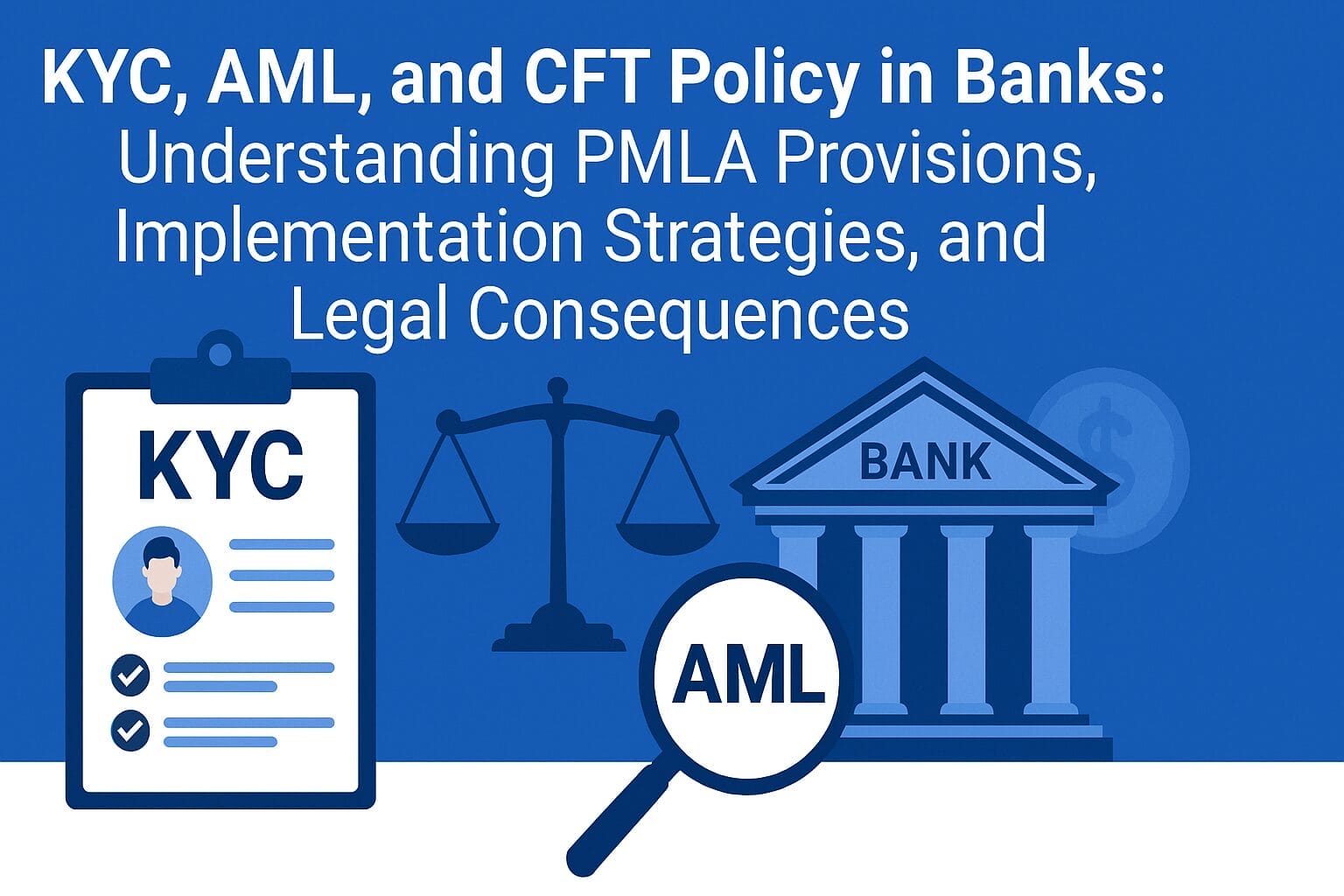
KYC, AML, and CFT Policy in Banks: Understanding PMLA Provisions, Implementation Strategies, and Legal Consequences

Key Takeaways
- Banks must retain all domestic and international transaction records for a minimum of five years as mandated under the PMLA’s record-keeping provisions.
- Failure to comply with PMLA can result in fines up to INR 5 crore and imprisonment of three to seven years under Section 4 of the Act.
- Under AML regulations, banks are required to report any suspicious transactions to the Financial Intelligence Unit-India (FIU-IND) without delay.
- CFT compliance mandates banks to screen all customers against the United Nations Security Council sanctions lists, updating their watchlists regularly.
- Enhanced due diligence is compulsory for high-risk customers—including those from high-risk jurisdictions or with complex corporate structures—with quarterly reviews of source of funds.
Banks in India must strictly comply with the Prevention of Money Laundering Act (PMLA) to follow KYC, AML, and CFT policies. These regulations are vital in fighting money laundering and ensuring financial integrity.
Implementing strong KYC and AML processes helps banks manage risks effectively. In high-risk scenarios, banks need to take extra steps to protect themselves and their customers.
Compliance is crucial for banks to avoid severe penalties and reputational damage. Non-compliance can lead to significant legal consequences under the PMLA, placing the bank’s operations at risk.
Banks should conduct enhanced due diligence when they identify suspicious activities. Knowing the indicators can help prevent wrongdoing and secure the banking system.
Overall, understanding the PMLA and its implications keeps our financial environment safe and trustworthy. By following these guidelines, banks can play a significant role in combating financial crimes.
What Are the Key Provisions of the PMLA That Banks Must Follow to Ensure Compliance with KYC, AML, and CFT Regulations?
Compliance with the Prevention of Money Laundering Act (PMLA) is vital for banks in India to mitigate risks associated with money laundering, terrorist financing, and other illicit activities. The PMLA sets clear guidelines that banks must follow to adhere to Know Your Customer (KYC), Anti-Money Laundering (AML), and Counter Financing of Terrorism (CFT) regulations. Understanding these provisions helps banks maintain integrity and customer trust.
What Are the Core Objectives of the PMLA?
The PMLA aims to prevent money laundering and identify the sources of illicit funds. Its objectives include:
- Prohibiting money laundering activities
- Identifying, investigating, and prosecuting money laundering offenses
- Maintaining the integrity and stability of the financial system
These core objectives guide banks in creating robust policies and procedures.
What Should Banks Do for KYC Compliance?
KYC compliance is essential for all financial institutions. The PMLA mandates the following KYC provisions for banks:
- Customer Identification: Verify the identity of customers looking to open accounts.
- Customer Due Diligence (CDD): Obtain information about the customer’s financial dealings to understand the nature of their activities.
- Monitoring of Transactions: Regularly check transactions against established patterns to identify suspicious activities.
- Record Keeping: Maintain records for a minimum of five years for all transactions, whether domestic or international.
These steps ensure that banks have accurate information and can effectively monitor activities.
How Do AML Regulations Help Banks?
AML provisions under the PMLA require banks to implement controls to detect and prevent money laundering. Key requirements include:
- Risk Assessment: Regularly assess risks associated with different products, services, and customer types.
- Reporting Suspicious Transactions: Report any suspicious transactions to the Financial Intelligence Unit-India (FIU-IND).
- Training Employees: Conduct regular training sessions for employees about AML and compliance procedures.
By adhering to these regulations, banks can significantly reduce the risk of complicity in money laundering activities.
What CFT Measures Are Essential for Banks?
Counter Financing of Terrorism (CFT) is another critical aspect banks must consider. Essential CFT measures include:
- Screening Customers: Use updated lists from the United Nations Security Council to check for individuals associated with terrorism.
- Transaction Monitoring: Implement systems to identify transactions that are unusual or potentially linked to terrorist financing.
- Collaboration with Authorities: Work closely with law enforcement agencies and regulatory bodies to enhance CFT initiatives.
These measures help banks become active participants in fighting terrorism financing.
How Do Banks Monitor Compliance?
To ensure adherence to KYC, AML, and CFT provisions, banks should implement monitoring frameworks. This includes:
- Regular audits of compliance programs
- Self-assessments of KYC and AML efforts
- Engaging third-party specialists for independent reviews
By following these monitoring practices, banks can determine the effectiveness of their compliance efforts.
What Happens If Banks Fail to Comply?
Failure to comply with PMLA provisions can have significant consequences, including:
- Fines: Financial penalties for non-compliance can be substantial.
- Legal Action: Banks may face criminal charges if found complicit in money laundering.
- Reputational Damage: Loss of trust can impact existing and potential customers.
Let’s see a comparison of compliance areas under KYC, AML, and CFT.
| Compliance Area | Key Requirement | Frequency of Review |
|---|---|---|
| KYC | Customer Identification and Due Diligence | At account opening and periodically |
| AML | Monitoring of Transactions and Reporting | Ongoing |
| CFT | Screening against sanction lists | Regularly updated |
Need Legal Assistance?
If you have questions about PMLA compliance for banks, you might find these FAQs helpful.
What is the minimum record-keeping duration for KYC compliance?
Banks must retain KYC-related records for at least five years after the account closure or transaction completion.
How often should banks review their AML policies?
Banks should review their AML policies regularly, ideally annually, to address any evolving risks.
What penalties can banks face for failing CFT compliance?
Penalties can include hefty fines and potential criminal liabilities for banks found non-compliant.
By understanding these provisions of the PMLA, banks can strengthen their policies and ensure compliance with KYC, AML, and CFT regulations effectively.
How Can Banks Effectively Implement KYC, AML, and CFT Policies to Prevent Money Laundering in High-Risk Scenarios?
Banks can implement effective KYC (Know Your Customer), AML (Anti-Money Laundering), and CFT (Counter Financing of Terrorism) policies by establishing robust systems to identify, assess, and monitor risks associated with clients and transactions, especially in high-risk scenarios.
What Are the Key Elements of a Strong KYC Policy?
A solid KYC policy includes several critical elements that help banks build a framework for compliance. These elements ensure that banks thoroughly understand their clients and mitigate risks effectively:
- Customer Identification: Banks must verify customers’ identities using reliable documents before establishing any relationship.
- Risk Assessment: Classifying customers based on risk levels allows banks to apply appropriate measures tailored to each risk category.
- Ongoing Monitoring: Banks need to constantly monitor transactions to detect any suspicious activity.
By integrating these elements, banks can better protect against potential money laundering activities.
How Do Banks Conduct Risk Assessments?
Risk assessment involves evaluating various factors associated with customers and their transactions.
- Client Information: Gather comprehensive details about clients, including their financial history, occupation, and business nature.
- Geographic Risk: Consider the client’s location. Clients from high-risk jurisdictions require stricter controls.
- Transaction Types: Evaluate transaction patterns, identifying any unusual behavior or irregularities.
- Business Relationships: Analyze connections a client has with other businesses, which can highlight potential risks.
A proper risk assessment allows banks to tailor their KYC measures accordingly and prioritize clients that need closer scrutiny.
What Steps Should Banks Follow to Implement AML and CFT Practices?
To efficiently implement AML and CFT policies, banks must follow several key steps:
- Establish a Compliance Team: Appoint trained personnel responsible for AML and CFT compliance.
- Develop Internal Policies: Create clear, updated policies and procedures outlining compliance requirements.
- Provide Training: Regularly train bank staff on AML and CFT regulations and the importance of reporting suspicious activities.
- Utilize Technology: Implement anti-money laundering software for real-time transaction monitoring and alerts.
These steps contribute to a culture of compliance within the organization.
What Role Does Technology Play in Preventing Money Laundering?
Technology is increasingly crucial in combating financial crime. Here are some ways it assists in KYC, AML, and CFT processes:
- Automated Monitoring: Banks can use software that automatically flags suspicious transactions.
- Data Analytics: Advanced analytics help identify patterns and trends that signify potential money laundering.
- Blockchain for Transparency: Blockchain technology enhances tracking of transactions, adding a layer of security and transparency.
These advancements position banks to respond swiftly to any irregularities detected.
Comparison of KYC Procedures in Different Risk Scenarios
| Risk Level | Verification Procedures | Monitoring Frequency |
|---|---|---|
| Low Risk | Basic identity verification (ID proof) | Annual review |
| Medium Risk | Enhanced verification (income proof, residency documents) | Biannual review |
| High Risk | Thorough verification (source of funds, business background checks) | Quarterly review |
This table illustrates how banks should customize KYC procedures based on different risk levels.
Need Legal Assistance?
If your bank needs guidance on implementing KYC, AML, and CFT policies, legal expertise can ensure compliance with the PMLA regulations.
Frequently Asked Questions
What happens if a bank fails to implement adequate controls?
Failure to implement proper controls can result in legal penalties and financial loss for the bank.
How can banks ensure staff are trained on AML regulations?
Banks should provide regular training sessions and updates on AML regulations to ensure staff are informed.
What are the consequences of non-compliance for banks?
Non-compliance can lead to fines, legal actions, and damage to the bank’s reputation.
By actively engaging in KYC, AML, and CFT practices, banks can effectively minimize risks associated with money laundering.
Why Is Compliance with KYC, AML, and CFT Policies Crucial for Banks Operating in India Under the PMLA?
Compliance with Know Your Customer (KYC), Anti-Money Laundering (AML), and Counter Financing of Terrorism (CFT) policies is vital for banks in India under the Prevention of Money Laundering Act (PMLA). It helps prevent financial crime, secures the banking system, and protects the reputation of financial institutions.
What Are the Legal Foundations Behind KYC, AML, and CFT?
The PMLA was enacted to combat money laundering and provide for the confiscation of property derived from money laundering. It outlines specific responsibilities for banks, making it mandatory to verify the identity of their clients. Compliance with the KYC norms helps banks mitigate risk and ensure that they do not become unwitting conduits for criminal activities.
How Do KYC and AML Policies Protect Financial Institutions?
KYC and AML policies are designed to identify and verify the customers’ identities, which helps identify suspicious activities early on. By implementing these policies, banks can:
- Prevent financial losses due to fraud.
- Avoid penalties imposed by regulatory authorities.
- Safeguard their reputation in the market.
What Are the Risks of Non-Compliance?
Non-compliance with KYC, AML, and CFT guidelines poses several risks for banks. These include:
- Legal repercussions, including heavy fines.
- Suspension of banking licenses.
- Reputational damage that can take years to recover from.
| Risk Type | Potential Consequences |
|---|---|
| Legal Repercussions | Heavy fines, lawsuits |
| Operational Risks | Loss of business and revenue |
| Reputational Damage | Loss of customer trust |
What Role Does Regulatory Oversight Play?
The Financial Intelligence Unit (FIU) and the Reserve Bank of India (RBI) oversee KYC, AML, and CFT compliance. They ensure that banks adhere to regulations to maintain a robust financial system. Regular audits and inspections help verify adherence to these laws.
What Measures Can Banks Implement for Effective Compliance?
To ensure compliance, banks can take the following steps:
- Regularly train employees on current KYC, AML, and CFT laws.
- Implement advanced technology systems for transaction monitoring.
- Establish a dedicated compliance team within the organization.
- Conduct routine reviews of customer accounts to catch irregularities.
Need Legal Assistance?
If your bank needs help navigating compliance with KYC, AML, and CFT policies under the PMLA, consider reaching out for legal guidance. Our firm specializes in these areas and can assist you in developing effective strategies.
FAQs
What is KYC?
KYC stands for Know Your Customer. It is a process to verify the identity of clients before establishing a business relationship.
What can happen if a bank does not comply with AML regulations?
A bank may face legal penalties, operational disruptions, and reputational harm if it fails to comply with AML regulations.
How often should KYC checks be conducted?
KYC checks should be done at the onset of the customer relationship and regularly reviewed as per the risk category of the customer.
When Should Banks Conduct Enhanced Due Diligence Under KYC, AML, and CFT Regulations, and What Are the Indicators?
Banks should conduct enhanced due diligence (EDD) when they identify clients or transactions that present higher risks of money laundering or terrorist financing. This typically happens under various circumstances such as customer profile, geographical locations, or transaction types.
What Triggers Enhanced Due Diligence?
There are several situations where enhanced due diligence is necessary:
- High-Risk Customers: Clients involved in high-risk industries like gambling, arms trading, or precious metals.
- Geographical Risk: Transactions involving countries known for inadequate anti-money laundering laws.
- Large or Unusual Transactions: Any transaction that is significantly larger than the known or typical customer profile.
- Complex Structures: Transactions involving complex corporate structures or shell companies.
How Do Banks Implement Enhanced Due Diligence?
Banks can follow a systematic approach to implement EDD processes:
- Risk Assessment: Assess the risk profile of the customer or transaction.
- Gather Additional Information: Request more documents or clarification from the client.
- Detailed Verification: Conduct a deeper examination of the customer’s background and funding sources.
- Ongoing Monitoring: Increase frequency and depth of transaction monitoring.
What Are the Indicators of High-Risk Transactions?
Monitoring for specific indicators can alert banks to high-risk transactions. Here are some red flags:
- Inconsistent Information: Discrepancies in the personal details provided by clients.
- Frequent Large Deposits: Multiple large transactions that are inconsistent with a customer’s known business operations.
- Wire Transfers to High-Risk Jurisdictions: Transfers to or from countries identified as high-risk.
- Unusual Patterns: Transactions that have no apparent economic rationale.
Comparison of Enhanced Due Diligence Procedures
| Procedure | Standard Due Diligence | Enhanced Due Diligence |
|---|---|---|
| CUSTOMER IDENTIFICATION | Basic checks against ID | In-depth background checking |
| TRANSACTION MONITORING | Periodic review | Frequent alerts and active review |
| RISK ASSESSMENT | Standard questionnaire | Customized assessment based on various risk factors |
Need Legal Assistance?
If your bank requires support in implementing EDD measures or navigating KYC regulations, we can help. Contact us for expert advice tailored to your needs.
Frequently Asked Questions
What happens if a bank fails to conduct EDD?
If a bank skips EDD in a high-risk situation, it may expose itself to legal and financial repercussions, including penalties.
How often should EDD be conducted?
EDD should be conducted periodically, especially for higher risk customers or when there are significant changes in transaction patterns.
Which Legal Consequences Can Banks Face in India for Failing to Adhere to KYC, AML, and CFT Guidelines Imposed by the PMLA?
Banks in India can face severe legal consequences for not following Know Your Customer (KYC), Anti-Money Laundering (AML), and Counter Financing of Terrorism (CFT) guidelines set by the Prevention of Money Laundering Act (PMLA). These penalties can include fines, criminal liability, and restrictions on conducting business.
What Are the Fines for Non-Compliance?
Under the PMLA, banks that fail to comply with KYC and AML regulations may be subject to hefty fines. The maximum penalty can reach up to INR 5 crore. Additionally, banks may incur further fines based on the severity of the offense. Frequent failures can lead to an increase in penalties.
- Initial fines typically range from INR 1 lakh to INR 10 lakh.
- Repeat offenses may see fines escalate significantly.
- The Enforcement Directorate (ED) actively pursues such cases, making fines likely.
Is There a Risk of Criminal Liability?
Yes, banks may face criminal charges for violating PMLA regulations. Senior officials in the bank may be held personally liable. Under Section 4 of the PMLA, individuals found guilty could face imprisonment of three years or more. Thus:
- Employees involved in negligent oversight may be prosecuted.
- The term of imprisonment could vary depending on the level of negligence.
- Serious offences could lead to imprisonment of up to seven years.
Can Banks Lose Their License?
Failure to comply can also result in the suspension or revocation of a bank’s license. The Reserve Bank of India (RBI) monitors compliance rigorously. If a bank consistently shows disregard for these laws, it risks its operational license, limiting its ability to conduct banking activities. Immediate actions include:
- A temporary suspension of banking operations while under investigation.
- A potential withdrawal of the banking license if found guilty.
How Does This Impact Banking Operations?
Non-compliance can cripple a bank’s ability to fulfill its functions. This includes freezing accounts associated with violations and halting transactions. A bank may also face restrictions on entering new markets or rolling out new products. The key impacts may involve:
- Delays in processing customer accounts due to investigations.
- Increased scrutiny from regulatory authorities.
- Damage to reputation, leading to loss of customer trust.
What Procedures Are in Place for Compliance?
Banks must implement strict KYC, AML, and CFT policies to avoid these repercussions. This involves:
- Developing comprehensive KYC policies.
- Training staff on compliance measures.
- Regular audits to ensure adherence to PMLA guidelines.
These measures assist banks in identifying and mitigating risks effectively.
Impact on Customers
Customers may also face consequences from a bank’s non-compliance. For instance, accounts may be frozen or closed pending an investigation. Banks could deny services temporarily. Customers are encouraged to maintain compliance with KYC requirements to avoid disruptions.
Compliance Checklist for Banks
To ensure compliance with KYC, AML, and CFT regulations, banks should follow a checklist:
- Establish a designated compliance officer.
- Conduct regular training sessions for employees.
- Implement an automated monitoring system for transactions.
- Maintain clear documentation of KYC procedures.
- Conduct risk assessments to identify high-risk clients.
Need Legal Assistance?
If your bank is facing challenges with KYC and AML compliance under the PMLA, seeking legal advice is crucial. Contact our law firm for tailored solutions and support. We help banks navigate complex legal landscapes and implement effective compliance protocols.
FAQ
What happens if a bank gets penalties for non-compliance?
They must pay the fines and may face increased scrutiny from regulators, impacting their operations.
Can individuals be penalized along with the bank?
Yes, bank officials can face personal fines or imprisonment if found negligent in compliance.
What are the indicators of a high-risk scenario for banks?
Indicators include large cash transactions, customers from high-risk countries, and unexplained account activity.
Conclusion
Banks must comply with PMLA regulations to avoid severe penalties and protect their operations.
To ensure your bank stays compliant, conduct regular audits of your KYC and AML procedures.
Provide ongoing training for staff to keep them updated on compliance requirements.
Consult with a legal expert to refine your policies and better mitigate risks.
A clear understanding of PMLA guidelines is essential for protecting your bank from legal consequences.
Prioritizing KYC, AML, and CFT practices maintains trust and security in the financial system.
By taking these steps, you can uphold compliance and safeguard your bank from penalties.


Pratham is a legal information researcher and content creator dedicated to making Indian law accessible to everyone. With expertise in legal research and content development, Pratham creates detailed, well-researched articles on Indian laws to help readers understand complex legal concepts in simple language. All content is thoroughly researched from authentic legal sources including Indian statutes, court precedents, government publications, and established legal databases. Each article is fact-checked and updated regularly to reflect current laws and amendments.