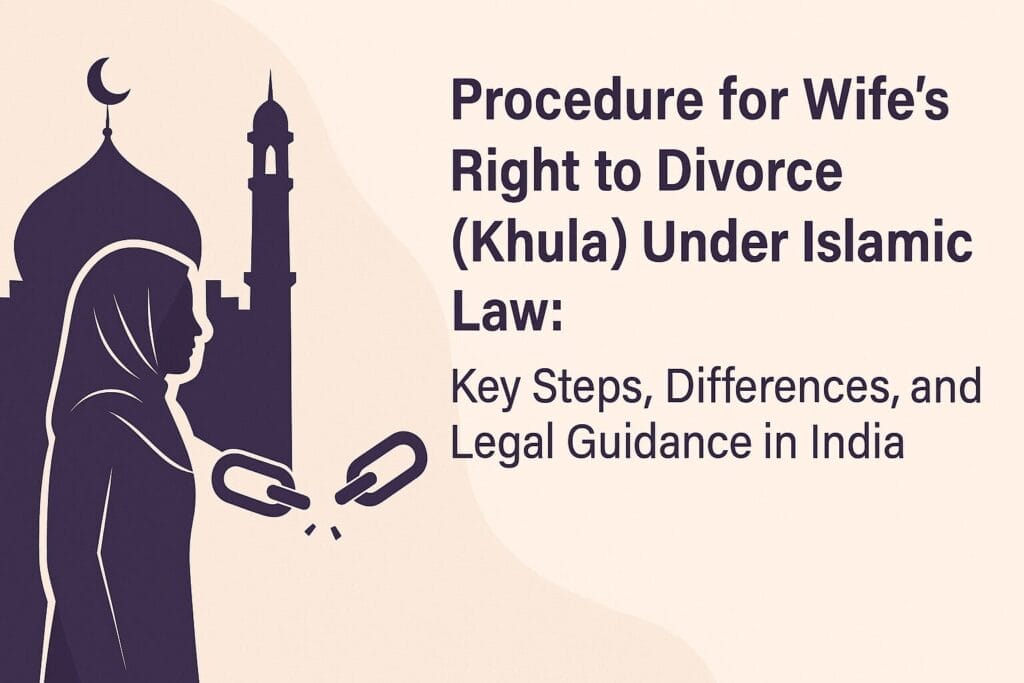
Procedure for Wife’s Right to Divorce (Khula) Under Islamic Law: Key Steps, Differences, and Legal Guidance in India
Key Takeaways
- Under the Muslim Personal Law (Shariat) Application Act, 1937, a Muslim woman can file a Khula petition in the family court without her husband’s consent.
- Filing for Khula requires submitting a petition with prescribed court fees, marriage certificate, Aadhaar or passport, address proof, and reconciliation evidence.
- Family courts often mandate at least one counseling or mediation session under the Family Courts Act to explore reconciliation before granting Khula.
- Upon granting Khula, the wife must return the mahr (dower) paid at marriage, which is a fundamental requirement under Islamic law.
- Unlike mutual consent divorce under Section 13B of the Hindu Marriage Act, which has a six-month cooling-off period, Khula can conclude within a few months based on court availability.
A woman can initiate Khula, or divorce under Islamic law, by following specific steps. Understanding this process is essential for her rights in India.
Many might confuse Khula with mutual consent divorce. But they differ significantly in their procedures and requirements.
It’s crucial for women to know their rights while seeking Khula. Ignorance can lead to hardships and missed opportunities.
Considering cultural and legal implications, there are times when Khula may be the better choice. A woman should weigh her options carefully.
Legal assistance is key in navigating the Khula process. Finding the right lawyer can make a significant difference in her experience.
What Are the Key Steps a Wife Must Take to Initiate the Khula Process Under Islamic Law in India?
To initiate the Khula process under Islamic law in India, a wife should follow specific legal steps. These steps include understanding her rights, preparing necessary documents, filing a petition in the family court, and attending court hearings.
What Documents Are Necessary for Khula?
Before starting the Khula process, a wife needs to gather the following documents:
- Marriage certificate
- Identity proof (Aadhaar card or passport)
- Address proof
- Evidence of attempts to reconcile, if applicable
- Any documents supporting her request for dissolution of marriage
These documents help establish the marriage and the basis for seeking Khula.
What Is the Legal Procedure to File for Khula?
The legal procedure for Khula generally includes these steps:
- Petition Filing: The wife files a petition for Khula in the family court.
- Court Fees: Pay the prescribed court fees along with the petition.
- Hearing Date: The court will schedule a hearing.
- Counseling Sessions: Often, courts mandate counseling sessions to explore reconciliation.
- Judgment: If the court deems the reasons valid, it grants Khula.
Each step is essential in ensuring the process adheres to legal requirements.
How Does the Personal Law Impact the Khula Procedure?
The Khula procedure is guided by personal laws under the Muslim personal law system. Key points include:
- Right of Wife: A wife has the right to seek Khula based on unhappiness in the marriage.
- Return of Dower: In many cases, the wife must return the dower (mahr) given at the time of marriage.
- Judicial Discretion: Courts have the discretion to allow or deny Khula based on individual circumstances.
Understanding these aspects of personal law is crucial for initiating Khula.
Why Is Mediation Often Required Before Khula is Granted?
Mediation is typically required to ensure both parties have attempted to resolve their differences. Key reasons include:
- Encouraging Reconciliation: Mediation offers a chance for couples to work through issues.
- Legal Requirement: Many family courts mandate mediation efforts.
- Faster Resolution: Some cases may resolve without needing a full court proceeding.
Mediation can save time and emotional strain for both parties.
Comparison of Khula and Other Divorce Types
Here’s a comparison of Khula and mutual consent divorce:
| Aspect | Khula | Mutual Consent Divorce |
|---|---|---|
| Initiator | Wife | Both Parties |
| Grounds | Unhappiness or incompatibility | Agreement between both |
| Mediation | Often required | Encouraged |
| Dower (Mahr) | Usually must be returned | Not applicable |
| Timeline | Varies greatly | Typically faster |
This comparison highlights the unique nature of Khula in the landscape of divorce laws in India.
What Are the Common Challenges Faced During the Khula Process?
Women seeking Khula might face several challenges, including:
- Societal Stigma: Women may face judgment from family and society.
- Emotional Stress: The process can be emotionally taxing.
- Legal Complications: Lack of awareness about legal rights can create hurdles.
Being prepared for these challenges can make the process smoother.
Need Legal Assistance?
If you are considering Khula, having legal advice is important. A lawyer can guide you through the steps and represent your interests effectively.
When selecting a lawyer, consider:
- Experience: Look for someone experienced in family law.
- Communication: Ensure the lawyer communicates clearly and effectively.
- Reputation: Check reviews or ask for recommendations from trusted sources.
Making an informed choice can ease the entire process.
Frequently Asked Questions
Q1: Can a wife petition for Khula without the husband’s consent?
A1: Yes, a wife can file for Khula without her husband’s consent, but the court will assess the reasons.
Q2: How long does the Khula process typically take?
A2: The timeline varies based on court schedules and individual circumstances, but it can take several months.
Q3: Is it necessary to attend court hearings for Khula?
A3: Yes, the wife is usually required to attend court hearings as part of the process.
How Do Islamic Divorce and the Khula Procedure Differ From Other Types of Divorce in India, Such as Mutual Consent Divorce?
Islamic divorce, specifically Khula, differs significantly from other divorce types in India, particularly mutual consent divorce. In Khula, a woman initiates the divorce process by returning her marriage dowry to her husband, which allows her to seek freedom from the marriage. In contrast, mutual consent divorce involves both spouses agreeing to the divorce terms without the need for any financial compensation.
What Is Khula, and How Does It Work?
Khula is a form of divorce available to Muslim women under Islamic law in India. It permits a wife to dissolve her marriage by offering to return her mahr (dower) to her husband. This ensures that the husband retains some financial consideration while allowing the wife to walk away from an unhappy marriage. The procedure mainly involves filing a suit in a family court, which operates under Islamic law provisions.
How Does Mutual Consent Divorce Function?
Mutual consent divorce is designed for couples who agree to separate amicably. Both partners submit a joint petition to the court, stating their intention to end the marriage. Key aspects include:
- Joint Agreement: Both spouses must agree on the divorce.
- Grounds for Divorce: No specific grounds are needed, just mutual consent.
- Court Proceedings: The couple must attend court hearings, usually requiring a waiting period of six months.
- Settlement of Assets: Both parties can negotiate on property, child custody, and support.
While Khula requires a financial exchange and can follow a unilateral decision from the wife, mutual consent emphasizes collaboration and shared agreements.
What Are the Key Differences Between Khula and Mutual Consent Divorce?
Here’s a comparison table that highlights the differences between Khula and mutual consent divorce:
| Aspect | Khula | Mutual Consent Divorce |
|---|---|---|
| Initiation | By the wife | By both spouses |
| Financial Requirement | Return of mahr | Negotiated settlement |
| Legal Grounds | Not required | Mutual agreement |
| Proceedings Duration | Varies; usually shorter | At least 6 months |
| Emotional Context | Often unilateral and emotional | Collaborative and amicable |
What Legal Protections Are Available for Women Seeking Khula?
Women pursuing Khula should understand their legal rights. In India, Islamic law grants women the following protections:
- Right to Initiate: A woman can proactively seek divorce.
- Financial Rights: The return of mahr aids in ensuring some financial independence post-divorce.
- Legal Representation: Women have the right to legal representation throughout the process.
Understanding these protections helps a woman navigate the emotional and legal challenges involved in seeking a divorce through Khula.
What Are the Challenges Women Face in the Khula Process?
Several challenges can arise during the Khula process, including:
- Cultural Stigma: Walking away from a marriage can attract negative attention in some communities.
- Financial Disputes: Disagreements over the mahr and property division may complicate matters.
- Legal Complexities: Women may face obstacles if their husbands contest the divorce or refuse to return the mahr.
Awareness of these issues can aid women in preparing for their Khula journey.
Need Legal Assistance?
Women considering Khula should seek legal advice to understand their rights clearly. It is essential to select a lawyer experienced in Islamic family law. Here are points to consider when choosing a legal representative:
- Experience: Look for lawyers who specifically handle Islamic divorce cases.
- Reputation: Check online reviews or ask for referrals from trusted sources.
- Communication: Ensure the lawyer is approachable and willing to answer questions.
- Fee Structure: Discuss fees upfront to avoid any surprise costs.
Through careful selection and understanding of the legal landscape, women can navigate their Khula journey more effectively.
Frequently Asked Questions
What is the time frame for a Khula divorce?
The time frame can vary widely, but Khula is often quicker than mutual consent divorce and may take a few months, depending on case complexities.
Can a wife refuse to return the mahr?
Returning the mahr is a fundamental requirement in Khula. Refusal can lead to legal complications and potential rejection of the divorce petition.
Is Khula accepted in all regions of India?
Yes, Khula is recognized under Islamic law across India. However, local customs and practices may influence its acceptance and procedure.
Why Is It Important for a Woman to Understand Her Rights and Options When Seeking Khula in India?
Understanding rights and options is crucial for a woman seeking Khula in India. Knowledge empowers women to make informed decisions about their lives. It ensures they are not taken advantage of during the divorce process, which can be emotionally and legally complex.
What Are the Legal Frameworks Supporting a Woman’s Rights?
Under Islamic law, Khula allows women to initiate divorce. The process is recognized in Indian courts, based on personal laws relevant to Muslims. It is vital for women to understand the Quranic and legal backing. The Muslim Personal Law (Shariat) Application Act, 1937 governs these rights. Women should know that they can seek Khula without relying on the husband’s consent. Knowledge of this right can remove barriers that might hold women back from pursuing a divorce.
What Options Are Available Beyond Khula?
While Khula is one option, women might also consider other forms of divorce such as:
– Talaq: Initiated by the husband.
– Mutual Consent Divorce: Both partners agree to end the marriage.
– Judicial Separation: A legal process that allows couples to live apart without ending their marriage formally.
Each option has distinct processes and implications. It is key for women to weigh these choices based on personal circumstances, especially regarding child custody and financial support.
What Are the Steps in the Khula Process?
Initiating Khula involves several steps. Here’s a brief overview of the process:
1. Understanding Rights: Know your legal rights under Islamic law.
2. Gathering Evidence: Keep documentation of marriage details and reasons for divorce.
3. Seeking Mediation: Attempt to resolve issues amicably, if possible.
4. Filing a Petition: Submit a petition for Khula in the relevant family court.
5. Court Hearing: Attend court hearings and present your case.
6. Decree of Divorce: Obtain a decree from the court finalizing the Khula.
Each step is crucial for ensuring a fair outcome and protecting one’s rights.
What Is the Emotional and Social Impact of Understanding Rights?
Knowledge about rights reduces emotional stress. Women often feel alone or unsupported during divorce. When they know their options, confidence grows. Empowerment leads to better negotiations, whether for financial support or child custody. Women can approach the situation from a place of strength.
How Can Legal Help Improve the Khula Process?
Legal assistance is vital in the Khula process. A qualified lawyer ensures that rights are protected. They provide guidance throughout the process. Here are some reasons to seek legal help:
– Familiarity with local laws and procedures.
– Assistance in preparing necessary documents.
– Representation in court to communicate effectively.
– Help in negotiating settlements with the husband.
Comparison of Divorce Types in India
Here’s a quick comparison of the main divorce types available to women in India:
| Type of Divorce | Initiator | Consent Required | Legal Complexity |
|---|---|---|---|
| Khula | Wife | No | Moderate |
| Talaq | Husband | No | Simple |
| Mutual Consent | Both | Yes | Simple |
| Judicial Separation | Either | No | Moderate |
This table highlights key differences. It helps women choose the best path for their situation.
Need Legal Assistance?
Women facing Khula should seek legal advice. Here are ways to find the right lawyer:
– Specialization: Look for a lawyer who specializes in family law and Islamic divorce.
– Experience: Choose someone with a proven track record in Khula cases.
– Client Reviews: Consider feedback from former clients.
– Initial Consultation: Schedule a meeting to gauge comfort and understanding.
Women deserve support during this process. Legal help can make a significant difference.
FAQs
1. Can a woman file for Khula without her husband’s consent?
Yes, a woman can file for Khula without the husband’s consent, as per Islamic law.
2. Is mediation mandatory before filing for Khula?
Mediation is not mandatory but is encouraged to resolve issues amicably.
3. How long does the Khula process take in India?
The duration varies but typically takes 6 months to a year, depending on court schedules and complexity.
When Should a Wife Consider Filing for Khula Instead of Other Divorce Options, Given the Cultural and Legal Implications?
A wife may consider filing for Khula when she feels the marriage is no longer viable, especially if she faces issues like neglect, abuse, or a lack of mutual respect. Khula offers specific rights to women under Islamic law, making it a significant option when all other avenues have been exhausted.
What Cultural Factors Influence the Decision to Seek Khula?
Cultural norms can heavily influence a woman’s decision to file for Khula. In many communities, divorce can carry a stigma. Women may fear social ostracism. However, if a marriage is abusive or unfulfilling, Khula can be an empowering choice. Understanding the cultural backdrop helps women weigh their options carefully.
What Are the Legal Implications of Filing for Khula?
Legally, Khula allows a woman to initiate divorce by returning the dowry or any other mutually agreed upon compensation to her husband. This provides a formal path to divorce under Islamic law. Women should understand that Khula is different from civil divorce, which involves specific legal statutes independent of religious laws. Women may need to file court petitions to dissolve the marriage formally after obtaining Khula, based on existing laws.
Which Situations Necessitate Khula Over Other Divorce Types?
Here are specific scenarios where Khula might be preferable:
- Abusive Relationship: If a woman faces emotional or physical abuse, Khula could be a way to escape.
- Lack of Communication: Continuous misunderstandings or lack of respect can warrant Khula.
- Religious Grounds: A woman wishing to practice her faith without restrictions may seek Khula.
- Custodial Concerns: Women with children may want legal autonomy to ensure a better future for them.
How Does Khula Compare with Other Divorce Options?
Here’s a table comparing Khula with mutual consent divorce in India:
| Aspect | Khula | Mutual Consent Divorce |
|---|---|---|
| Initiation | By the wife | Both partners agree |
| Grounds for Divorce | Generally unilateral | Joint decision |
| Legal Representation | May require a lawyer | Both may hire a joint lawyer |
| Compensation | Typically dowry is returned | May involve additional settlements |
| Cultural Stigma | High in some communities | Varies by region |
What Emotional Factors Should Be Considered?
Divorce is emotionally taxing. Women may experience sadness, fear, or relief. A supportive family and network can ease this transition. Reflection on emotional well-being before proceeding with Khula is crucial. It can help in making a sound decision.
What Steps Should a Woman Take Before Filing for Khula?
Before filing for Khula, I recommend these key steps:
- Seek Counseling: Find a counselor who understands cultural and religious issues.
- Document Everything: Keep records of any incidents that justify your decision.
- Discuss with Trusted Individuals: Talk to family or friends who can provide an objective view.
- Evaluate Alternatives: Explore other options such as reconciliation or separation.
- Consult a Lawyer: Understand legal implications and your rights.
Need Legal Assistance?
It’s beneficial to consult a lawyer specializing in Islamic law. They can guide you through the Khula process and ensure that your rights are protected. When seeking legal assistance, consider the following:
- Experience in Family Law: Ensure the lawyer understands both Islamic and Indian legal systems.
- Personal Rapport: A good lawyer should listen to your concerns and objectives.
- Clear Communication: Choose someone who explains legal terms in simple language.
Mini FAQ
What is the timeframe for the Khula process?
The Khula process can vary. It may take from a few months to over a year, depending on court schedules and complexities involved.
Can Khula be denied?
Yes, Khula can be denied if the court finds inadequate grounds or if mediation fails to resolve the issues.
Is there a financial settlement in Khula?
Typically, the wife must return the dowry. However, additional settlements may be discussed based on circumstances.
Who Can Provide Legal Assistance in the Khula Process, and How Can a Woman Choose the Right Lawyer for Her Specific Needs?
The khula process is complex, and a woman will benefit from legal assistance. A qualified lawyer with expertise in Islamic law is essential for navigating this process. They can provide the necessary guidance and representation.
What Should a Woman Look for in a Lawyer?
When selecting legal assistance for khula, consider these key factors:
- Experience with Islamic Law: A lawyer should have specific knowledge of Islamic divorce laws.
- Track Record: Look for a history of successful divorce cases.
- Client Reviews: Feedback from previous clients can offer insights into their service.
- Communication Skills: The lawyer must explain legal terms clearly and listen to your needs.
How Can One Find the Right Lawyer?
Finding the right lawyer involves several steps:
- Research: Start by looking for lawyers specializing in family law and Islamic law in your area.
- Consultations: Schedule initial meetings with potential lawyers to discuss your case.
- Ask Questions: Inquire about their experience, fees, and approach to handling your situation.
- Evaluate Comfort Level: You should feel comfortable discussing private issues with your lawyer.
What Are the Legal Points to Discuss with a Lawyer?
When consulting a lawyer, be prepared to discuss:
- Your Marriage: The duration and any complexities involved.
- Children: If you have kids, custody and support issues need addressing.
- Financial Concerns: Understand your rights regarding property and maintenance.
- Documentation: Ensure you ask what paperwork is needed for filing khula.
What Documents Are Needed for Khula?
Having the right documents is crucial for a smooth khula process. Here are some essential documents to gather:
- Marriage Certificate: A legal proof of marriage.
- Identity Proof: Such as Aadhar Card or Passport.
- Proof of Residence: A document showing your current address.
- Financial Statements: Any records showing income, assets, and debts.
Comparison of Legal Assistance Options for Khula
The following table outlines the differences between hiring a specialized lawyer versus general legal assistance for khula:
| Aspect | Specialized Lawyer | General Lawyer |
|---|---|---|
| Expertise | Deep knowledge of Islamic law | General understanding of family law |
| Focus | Prioritizes women’s rights in Islam | Broader focus on various cases |
| Success Rate | High in khula cases | Variable and less predictable |
| Knowledge of Process | Familiar with khula procedures | May lack specific legal know-how |
| Client Interaction | Personalized and supportive | May be less available for queries |
Need Legal Assistance?
If you seek a lawyer for khula, several platforms are available for assistance. Consider contacting legal aid organizations or local Islamic law firms for help. Look for ones that offer free consultations to discuss your situation.
Frequently Asked Questions
- Can a woman initiate khula without a lawyer? Yes, but legal guidance helps ensure that all processes are correctly followed.
- Is it expensive to hire a lawyer for khula? Legal fees vary, but many lawyers offer payment plans or tailored services for financial constraints.
- What if my husband disagrees with the khula? A qualified lawyer can help with mediation or represent your interests in court.
Conclusion
Understanding the Khula process empowers women to claim their rights effectively.
Before initiating Khula, women should consider gathering essential documents like the marriage certificate and identity proof. This preparation simplifies the process for filing.
Consulting with an experienced family law attorney is crucial. They can guide you through the complexities and ensure your rights are protected.
Remember, Khula allows a woman to initiate divorce without relying on her husband’s consent. Knowing this right is vital for your empowerment and decision-making.
Taking informed steps can lead to a smoother Khula process. I am here to provide clarity and support as you navigate this important journey.


Pratham is a legal information researcher and content creator dedicated to making Indian law accessible to everyone. With expertise in legal research and content development, Pratham creates detailed, well-researched articles on Indian laws to help readers understand complex legal concepts in simple language. All content is thoroughly researched from authentic legal sources including Indian statutes, court precedents, government publications, and established legal databases. Each article is fact-checked and updated regularly to reflect current laws and amendments.