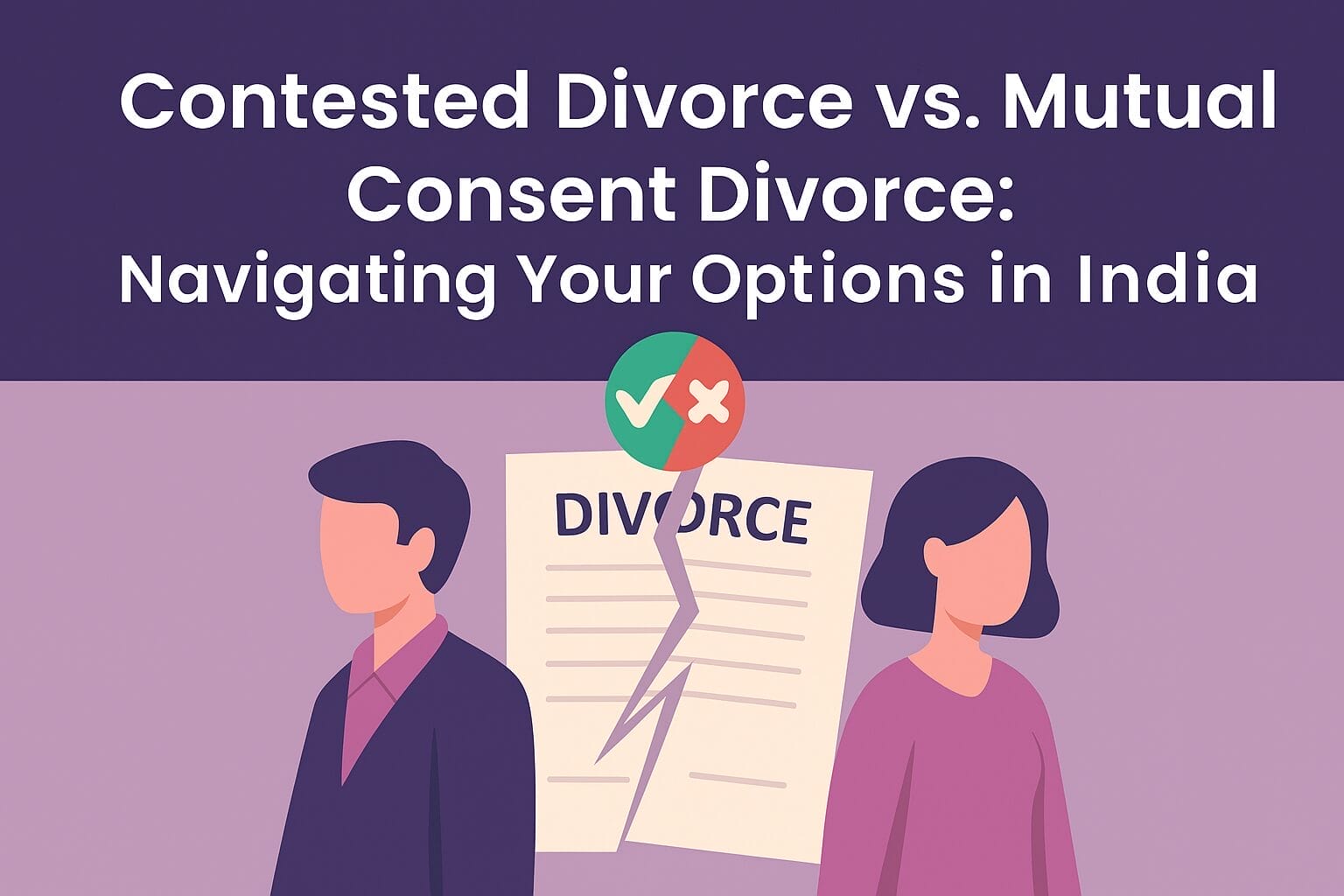
Contested Divorce vs. Mutual Consent Divorce: Navigating Your Options in India

Key Takeaways
- Under Section 13B of the Hindu Marriage Act, mutual consent divorce requires one year of living apart and a six-month cooling-off period before final decree issuance.
- Contested divorce under Section 13 of the Hindu Marriage Act demands substantiation of grounds like cruelty, adultery, or desertion and can extend over six months to three years in court.
- Victims of domestic violence under the Protection of Women from Domestic Violence Act, 2005 must first file a domestic violence complaint and obtain protection orders before initiating a contested divorce.
- Child custody in contested divorce prioritizes the child’s best interests, evaluating evidence of violence, emotional impact, and each parent’s caregiving capacity, often granting sole custody to the non-abusive parent.
- A mutual consent divorce involves drafting a settlement covering property division, alimony, and custody, filing a joint petition, attending two hearings, and securing the decree after the cooling-off period.
Choosing between contested divorce and mutual consent divorce can be daunting. It’s important to understand the key differences so you can pick the best path for you.
In India, mutual consent divorce is usually the smoother route, while contested divorce can be lengthy and complicated. The opinions of both partners play a huge role in your decision-making process, especially if you have minor children involved.
If you and your partner can agree on settlement terms, mutual consent might save you time and stress. However, in cases of domestic violence or severe disagreements, it may be necessary to opt for contested divorce.
Before making your decision, consulting a legal expert can provide you with tailored advice. Understanding your options can help you navigate this challenging time more effectively.
What Are the Key Differences Between Contested Divorce and Mutual Consent Divorce in India?
Contested divorce involves disagreements between partners and often ends in court, while mutual consent divorce occurs when both partners agree to end their marriage amicably.
What is a Contested Divorce?
A contested divorce arises when one spouse files for divorce without the other’s agreement. This often leads to disputes regarding property, alimony, and child custody. The case must be presented in front of a family court, which can prolong the process.
What is a Mutual Consent Divorce?
In a mutual consent divorce, both spouses file together. They agree on the terms, such as property division and custody matters, thus making it smoother and faster. This type usually takes only six months to finalize once filed.
How Do the Procedures Differ?
| Aspect | Contested Divorce | Mutual Consent Divorce |
|---|---|---|
| Filing Process | One spouse files; the other may contest. | Both spouses file together. |
| Duration | Can take years. | Usually takes six months. |
| Court Involvement | High; involves hearings and arguments. | Lower; limited to documentation review. |
| Settlement | Often contested and requires court intervention. | Agreed upon by both parties. |
What Are the Legal Grounds for Each Type?
In a contested divorce, you must provide valid reasons under Section 13 of the Hindu Marriage Act, 1955, or similar laws for other religions. Grounds include adultery, cruelty, or desertion.
For mutual consent divorce, both parties must state under Section 13B of the same Act that they have been living apart for at least a year and no reasonable chance of reconciliation exists.
What Are the Emotional and Financial Impacts?
Contested divorce typically results in emotional stress and hefty legal fees due to prolonged litigation. In contrast, mutual consent divorce can help save money and mental strain since both parties are on the same page.
Potential Scenarios for Each Option
- A husband finds out his wife is cheating: This could lead to a contested divorce.
- Both partners agree after many arguments: They might opt for mutual consent.
- A couple cannot decide on child custody: This can lead to a contested situation.
- Partners have no disagreements about terms: Mutual consent is ideal.
Need Legal Assistance?
Consulting a legal professional can help you understand which path is best for your situation. A lawyer can provide personalized advice based on your circumstances.
Mini FAQ
Can I change from contested to mutual consent divorce later?
You can if both parties agree to the change and meet the conditions for mutual consent.
Is there any cooling-off period for mutual consent divorce?
Yes, a minimum of six months is required as a cooling-off period in most cases.
What evidence is needed for a contested divorce?
Evidence must support claims like adultery or cruelty, including witness statements and documents.
How Can I Decide Which Divorce Option Is Best for My Situation If I Have Minor Children?
Choosing the right divorce option when you have minor children is crucial. It largely depends on your relationship with your spouse, your children’s needs, and the complexity of property and custody matters. Mutual consent divorce is often faster and less stressful, while contested divorce might be necessary if there is significant disagreement over children’s welfare or other issues.
What Are the Key Factors to Consider?
When deciding between divorce options, consider the following factors:
- Communication: Can you communicate openly with your spouse?
- Agreement on Custody: Do both parents agree on physical and legal custody?
- Financial Matters: Have you both come to a fair agreement regarding property and finances?
- Emotional Impact: How will each option affect your children emotionally?
What Type of Custody is Best for Your Children?
Custody arrangements can greatly affect your child’s well-being. Here’s a simplified view of the types of custody:
| Type of Custody | Description | Best For |
|---|---|---|
| Physical Custody | Child lives primarily with one parent. | A stable environment. |
| Legal Custody | Parents share decision-making rights. | Joint decisions on education and health. |
| Joint Custody | Child splits time between both parents. | Parents can cooperate well. |
What Are the Steps to Take for Each Option?
Here are some important steps and requirements for each divorce type:
For Mutual Consent Divorce:
- Draft a divorce agreement that includes child custody and financial support.
- File a petition in the family court.
- Attend court hearings when required.
- Finalize terms and receive your decree of divorce.
For Contested Divorce:
- Determine grounds for seeking a contested divorce (like cruelty, desertion).
- File a petition with supporting evidence.
- Prepare for lengthy court hearings.
- Work on establishing a custody arrangement through mediation, if possible.
What Are the Emotional Considerations for Your Children?
Divorce can be tough on children. Here are some emotional impacts to consider:
- Disruption of routine can lead to anxiety.
- Children may feel torn between parents.
- Support and understanding are crucial during this time.
Need Legal Assistance?
Consulting with a lawyer can provide clarity. A family law expert can guide you through custody laws, child support, and property matters. Their expertise will help you make a well-informed decision. Consider setting up an appointment to discuss your situation further.
Frequently Asked Questions
What if my spouse refuses to agree to a mutual consent divorce?
You may have to pursue a contested divorce. It’s best to consult a lawyer for proper guidance.
How long does a mutual consent divorce take?
Typically, it can take around 6 months, depending on court schedules and the complexity of the case.
What happens to child custody in a contested divorce?
The court will decide on custody based on the child’s best interests after considering various factors like living situation and the relationship with each parent.
Why Should I Consider Mutual Consent Divorce Over Contested Divorce if Both Partners Agree on Settlement Terms?
Opting for mutual consent divorce is beneficial when both partners agree on key issues such as property division, child custody, and alimony. This mutual agreement minimizes conflict and speeds up the divorce process.
What Are the Advantages of Mutual Consent Divorce?
Mutual consent divorce offers several key advantages:
- Faster process: The entire procedure can take as little as 6 months.
- Reduced legal fees: Less time spent in court means reduced costs.
- Less emotional stress: A collaborative atmosphere promotes understanding.
- Control over outcomes: Partners decide terms rather than leaving them up to a judge.
These benefits encourage many couples to choose mutual consent divorce since it encourages cooperation.
What Legal Steps Are Involved in Mutual Consent Divorce?
The legal process for mutual consent divorce is straightforward. Couples must follow these steps:
- File a joint petition for divorce in the relevant family court.
- Attend an initial hearing where both parties confirm their consent.
- Provide documentation for terms of settlement: property, custody, and maintenance.
- Wait for a 6-month cooling-off period if no child is involved.
- Attend a final hearing, where the court grants the divorce decree.
These steps illustrate how mutual consent divorce is a simpler route compared to contested divorce.
How Does Mutual Consent Divorce Compare to Contested Divorce?
The table below outlines key differences between mutual consent and contested divorce:
| Aspect | Mutual Consent Divorce | Contested Divorce |
|---|---|---|
| Duration | 6 months to 1 year | 1 to 5 years |
| Cost | Lower legal fees | Higher legal fees |
| Emotional Impact | Less stress | More stress |
| Control over Decisions | Partners decide | Court decides |
This table clearly shows that mutual consent divorce is more favorable for couples who agree on terms.
Are There Any Drawbacks to Mutual Consent Divorce?
While mutual consent divorce has many advantages, there are a few potential drawbacks:
- Both partners must fully agree on all terms.
- If one partner changes their mind, the process can halt.
- Usually, a cooling-off period is mandatory.
Awareness of these drawbacks helps partners weigh their options effectively.
Real Scenarios: When to Choose Mutual Consent Divorce
Consider these examples:
– Scenario 1: Both partners have no children and agree on sharing property. Mutual consent is a quick choice.
– Scenario 2: Couples disagree on child custody but have settled property distribution. They should consider contested divorce, focusing on custody issues.
These scenarios show practical applications of mutual consent divorce versus contested divorce.
Need Legal Assistance?
Choosing between mutual consent and contested divorce can be challenging. Consulting with a legal expert provides clarity and guidance tailored to your specific situation. A knowledgeable lawyer can help you understand your rights and the best path forward.
Mini FAQ
What if one partner does not agree to a mutual consent divorce?
Then a contested divorce becomes necessary, where the court will decide based on individual claims.
Can I change my mind after filing for mutual consent divorce?
Yes, you may withdraw your petition before the final decree.
Is mediation required for mutual consent divorce?
Mediation is not required, but it can help in reaching an agreement for terms easily.
These questions address common concerns regarding mutual consent divorce and provide quick insights for individuals considering this option.
When Is It Necessary to Choose Contested Divorce Over Mutual Consent Divorce, Especially in Cases of Domestic Violence?
Contested divorce is often necessary when one partner does not agree to the divorce or when there are serious issues, such as domestic violence. In such cases, mutual consent divorce becomes impractical due to a lack of agreement.
What Constitutes Domestic Violence?
Domestic violence refers to any form of abuse—physical, emotional, or financial—used by one partner to control the other. The Protection of Women from Domestic Violence Act, 2005, provides a legal framework to address such issues. This law protects women against domestic violence in various forms, including:
- Physical abuse
- Emotional abuse
- Verbal abuse
- Economic deprivation
When domestic violence is involved, a contested divorce may be essential to secure the safety of the victim.
What Are the Legal Steps in a Contested Divorce Due to Domestic Violence?
If faced with domestic violence, follow these steps:
- File a Domestic Violence Complaint: A victim can approach the police or seek help from a local women’s organization.
- Seek Protection Orders: The court can issue protection orders, ensuring safety from the abusive partner.
- File for Contested Divorce: After securing protection, you can initiate a contested divorce in family court.
The process is not only lengthy but also emotionally taxing, often requiring legal representation to navigate effectively.
What Challenges Might Arise in Contested Divorce Proceedings?
Contested divorce proceedings can be stressful and may involve various challenges:
- Delayed Resolutions: These cases may take months or even years to resolve.
- Emotional Toll: It can cause significant emotional stress for both parties and any children involved.
- Financial Strain: Legal fees can accumulate during prolonged court battles.
Here’s a comparison of contested vs. mutual consent divorce:
| Aspect | Contested Divorce | Mutual Consent Divorce |
|---|---|---|
| Duration | 6 months to 3 years | 3 to 6 months |
| Cost | Higher due to legal fees | Lower, generally |
| Emotional Impact | High stress | Lower stress |
| Agreement | Usually none | Both partners agree |
| Involvement of Children | Complex custody issues | Simpler custody agreements |
How Can Domestic Violence Affect Child Custody Decisions?
In cases of domestic violence, child custody is a crucial concern. Courts consider the child’s best interests first. Some factors include:
- Evidence of violence against the partner.
- Impact of the violence on the child’s well-being.
- Each parent’s ability to care for the child.
When domestic violence is proven, courts may grant sole custody to the non-abusive parent.
What If Both Partners Do Not Agree on Divorce?
If one partner refuses to file for a mutual consent divorce, the only option is a contested divorce. In such situations, the aggrieved partner must present valid grounds for the divorce. Grounds may include:
- Adultery
- Cruelty
- Desertion
If domestic violence is present, it can become solid grounds.
Need Legal Assistance?
Navigating a contested divorce, especially in cases of domestic violence, requires professional guidance. Understanding your rights and options can provide clarity and direction. Always consult a knowledgeable legal professional to explore your choices.
Mini FAQ
Can I file for divorce without proof of domestic violence?
Yes, you can file for divorce without proof of domestic violence, but contested divorces require established grounds.
Can mediation help in contested divorce cases?
Mediation may help, but it might not be suitable where domestic violence is involved, due to safety concerns.
How long does a contested divorce take?
A contested divorce can take anywhere from 6 months to 3 years, depending on the court’s schedule and the complexity of the case.
Who Should I Consult for Professional Guidance on Choosing Between Contested and Mutual Consent Divorce in India?
The best people to consult for guidance on divorce options in India are experienced family law attorneys and legal advisors. They can provide insights tailored to individual situations.
What Is the Role of a Family Law Attorney?
A family law attorney specializes in matters like divorce. They understand the nuances of contested and mutual consent divorce cases. Their expertise enables them to advise on legal rights, obligations, and procedures.
- Family law attorneys explain legal terminology.
- They help in drafting necessary documents.
- They represent clients in court if needed.
Consulting a lawyer helps clarify what each divorce type entails. This empowers individuals to make informed decisions.
When Should I Consult a Legal Advisor?
Seek a legal advisor early if considering divorce. Here are specific instances when consultation is vital:
- Clarifying legal rights related to children and property.
- Understanding potential financial implications.
- Discussing effective negotiation strategies for mutual consent.
- Learning about court procedures and timelines.
Legal advisors assist throughout the process. They help with paperwork, representation, and negotiations.
Where Can I Find a Qualified Attorney?
To find a qualified family law attorney in India, consider these steps:
- Ask for referrals: Friends or family may have recommendations.
- Research online: Look for legal directories or bar association listings.
- Consult legal aid organizations: They can help connect to qualified lawyers.
Choose an attorney who is experienced in family law to ensure competent guidance.
What Should I Expect During Initial Consultations?
In initial consultations, the attorney will ask questions to understand your situation. Expect to discuss:
- Reasons for considering divorce.
- Details about children, if any.
- Your financial situation and property ownership.
- Your preferences for an amicable or contested approach.
This information helps them tailor advice effectively.
Comparison of Professional Guidance Options
| Aspect | Family Law Attorney | Legal Advisor |
|---|---|---|
| Expertise | Specializes in family law | General legal advice |
| Document Preparation | Assists with court documents | May not offer in-depth help |
| Court Representation | Represents in court | Typically does not represent |
| Cost | Higher fees | Usually lower fees |
Choosing the right professional depends on specific needs and budget.
What Resources Are Available for Guidance?
In addition to legal professionals, consider other resources:
- Online forums and discussion groups: Connecting with others in similar situations may provide support.
- Legal clinics: Some law schools offer free or low-cost advice.
- Books and articles: Many resources discuss family law in India.
These resources can offer additional insights but are not substitutes for legal advice.
Need Legal Assistance?
If you’re facing decisions about divorce, consult a professional. Navigating these waters can be complex. Understanding your options can make the process smoother.
FAQs
1. How much does a consultation cost?
Costs vary, but many family law attorneys offer initial consultations free or at a low rate.
2. What if I can’t afford a lawyer?
You can seek help from legal aid organizations that provide services for low-income clients.
3. Is it necessary to hire a lawyer for mutual consent divorce?
While not strictly necessary, having a lawyer can ensure all terms are clearly laid out and legally binding.
Conclusion
Choosing mutual consent divorce can save time, money, and stress if both partners agree.
If you’re considering divorce, determine whether mutual consent or contested divorce fits your situation. Reflect on the key factors like communication, custody, and emotional well-being.
Consulting with a family law attorney can clarify your options. They can guide you through the legal requirements and help you draft necessary documents.
Start by gathering important documents related to your marriage and any children. Knowing your financial situation can help in discussions with your partner.
Divorce is tough, but understanding your options makes it easier. With legal expertise, you can navigate this process with confidence.


Pratham is a legal information researcher and content creator dedicated to making Indian law accessible to everyone. With expertise in legal research and content development, Pratham creates detailed, well-researched articles on Indian laws to help readers understand complex legal concepts in simple language. All content is thoroughly researched from authentic legal sources including Indian statutes, court precedents, government publications, and established legal databases. Each article is fact-checked and updated regularly to reflect current laws and amendments.