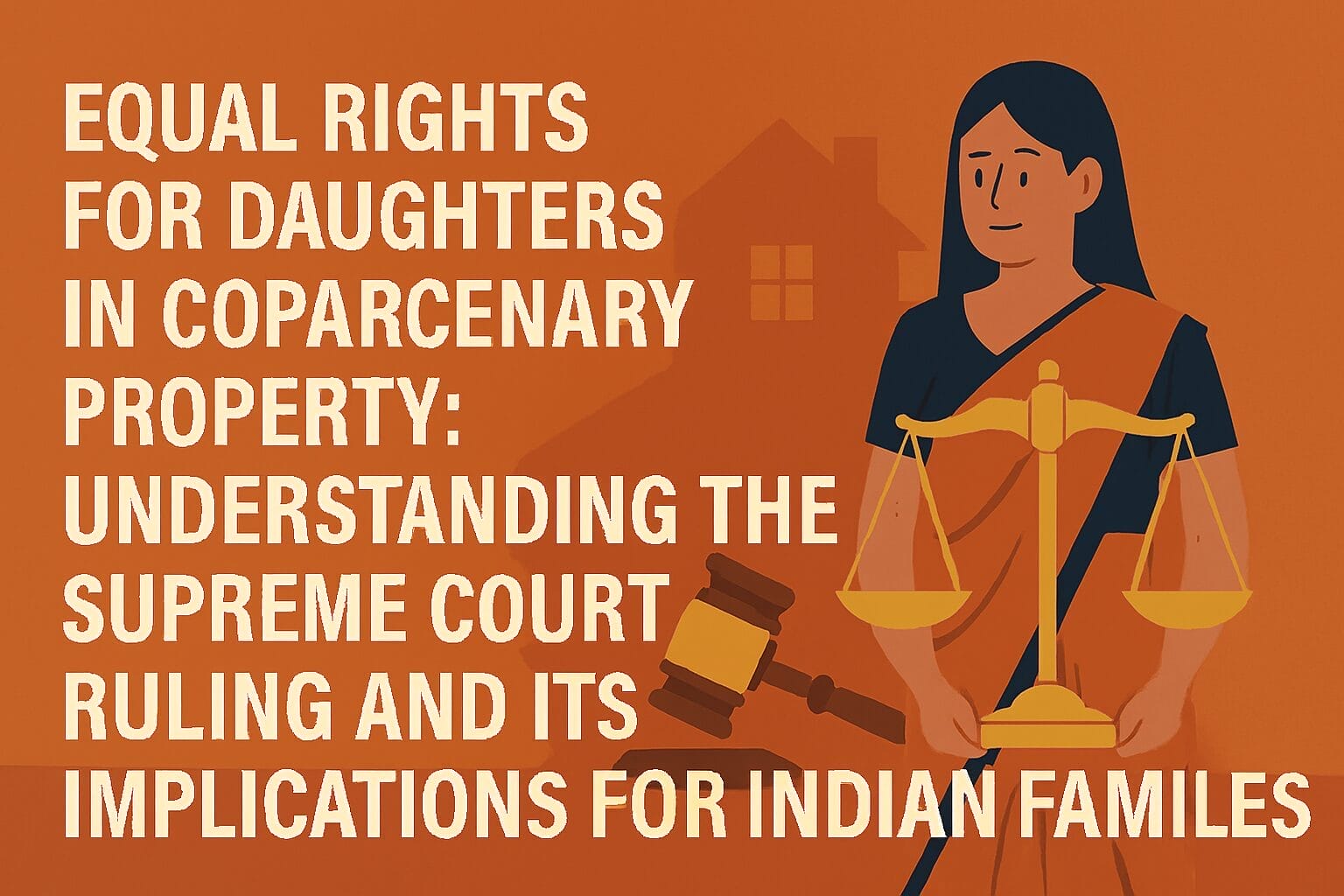
Equal Rights for Daughters in Coparcenary Property: Understanding the Supreme Court Ruling and Its Implications for Indian Families
Key Takeaways
- On 11 August 2020 in Vishaka Singh vs. State of Rajasthan, the Supreme Court ruled daughters have equal coparcenary rights regardless of whether their father was alive at the time of the amendment.
- The Hindu Succession (Amendment) Act, 2005 grants daughters coparcenary status equal to sons, and the Supreme Court affirmed this amendment applies retrospectively to pre-2005 cases.
- Daughters asserting coparcenary rights must collect ancestral property deeds, a certified family tree, and file a declaration or partition suit in civil court with a family law expert.
- The ruling extends to both Mitakshara and Dayabhaga schools of Hindu law, abolishing the historical male-only inheritance rule and ensuring equal shares for daughters.
- While there is no strict limitation period for filing a claim, initiating the process promptly secures key evidence and bolsters a daughter’s legal standing in property disputes.
The Supreme Court recently affirmed that daughters have equal rights in coparcenary property. This landmark ruling brings significant changes for families across India.
With this decision, daughters can claim a rightful share alongside their brothers. This is a vital step toward achieving gender equality in property rights.
Families can now navigate these rights more confidently, but they might need legal advice. Knowing how to assert these rights is crucial for daughters who want to benefit from this judgment.
Understanding the implications of the court’s ruling can empower families and promote fairness. In this post, we will explore the key details of this ruling and its significance for daughters in India.
What Are the Implications of the Supreme Court Ruling on Equal Rights for Daughters in Coparcenary Property for Families in India?
The Supreme Court ruling recognizes daughters as coparceners with equal rights to ancestral property. This landmark decision affects family structures, inheritance laws, and gender equality across India.
What Is Coparcenary Property?
Coparcenary property is a type of joint family property. It is governed by Hindu law and includes ancestral property. Traditionally, only male members had rights to such property. The recent ruling changes this dynamic.
- Ancestral Property: Property inherited from male ancestors.
- Joint Family: Family members who inherit property as a unit.
- Coparcener: A person who has legal rights in a coparcenary property.
This ruling means that daughters now hold the same rights as sons. This change aims to correct historical injustices regarding property rights.
How Has This Ruling Changed Family Dynamics?
Families may experience several changes because of this decision. The ruling has significant implications for the roles of daughters and mothers within families.
- Shifts in Power Dynamics: Daughters gain legal rights, challenging patriarchal norms.
- Increased Financial Security: Women can now claim their share of the family wealth.
- Encouragement of Gender Equality: This ruling supports women’s empowerment efforts.
By recognizing daughters’ rights, families must now consider both sons and daughters in inheritance planning.
What Are the Legal Background and Established Procedures?
Legally, the ruling states that daughters born before and after September 2005 have equal rights. The Hindu Succession Act underwent amendments to facilitate this change.
- Hindu Succession Act 1956: Originally, only sons could inherit coparcenary property.
- Amendment in 2005: Daughters were granted the same rights as sons, but the ruling now reinforces these rights.
- Supreme Court’s Interpretation: The court clarifies that the 2005 amendment applies retrospectively, affecting older cases.
Families should understand these legal aspects when navigating property rights.
How Can Daughters Assert Their Rights?
Daughters can assert their rights in coparcenary property through several steps:
- Gather Documentation: Collect evidence of the family tree, property details, and previous ownership.
- File a Claim: Submit a formal request for property division in a civil court.
- Seek Legal Counsel: Consult a lawyer specializing in family law for guidance.
Daughters may face resistance while asserting their rights. Legal support can help navigate these challenges effectively.
Comparison: Coparcenary Rights Pre and Post-Ruling
| Aspect | Before Ruling | After Ruling |
|---|---|---|
| Rights of Daughters | No legal rights | Equal rights as sons |
| Property Division | Based only on male lineage | Based on equal shares |
| Legal Support | Less accessibility for women | Encouraged to seek legal action |
This comparison highlights the significant shift following the Supreme Court’s ruling.
Need Legal Assistance?
Families seeking guidance on property rights should consult legal advisors knowledgeable about the Supreme Court ruling. Here are some key reasons to seek professional advice:
- Understanding Rights: Knowing specific entitlements under the law.
- Navigating Complex Cases: Handling unique property situations with care.
- Facilitating Disputes: Mediating conflicts with family members effectively.
Daughters should be aware of their ability to seek justice when facing obstacles in asserting their rights.
Mini FAQ
Can daughters claim property if their father has passed away?
Yes, daughters can claim their share of ancestral property even if their father has died, as the ruling is retroactive.
What should a daughter do if her family does not recognize her claim?
She should consult a lawyer and consider filing a case in civil court to assert her rights.
Is there a time limit for filing a claim?
While there is no strict time limit, acting quickly is advised to secure evidence and legal standing.
The ruling provides daughters with a platform for asserting their rights. This significant change reflects ongoing progress in gender equality within India’s legal framework.
How Can Daughters Assert Their Rights in Coparcenary Property After the Landmark Supreme Court Judgment?
Daughters can assert their rights in coparcenary property by claiming equal share as per the Supreme Court ruling. They must formally seek recognition of these rights within their family, and, if necessary, pursue legal action to affirm their status.
Understanding Coparcenary Rights
Under Hindu law, coparcenary property includes ancestral property passed down through generations. The Supreme Court ruling gives daughters equal rights in such property as sons. This means that daughters can now claim their rightful share just like their male siblings.
Steps to Assert Rights
Daughters can follow these steps to ensure their rights are recognized:
- Understand the Supreme Court ruling on equal rights.
- Request a formal acknowledgment of their share from family members.
- Gather relevant documents, such as property records.
- Consult a legal expert well-versed in family law.
- If needed, file a petition in court to assert rights.
Legal Documentation Needed
To assert rights effectively, certain documents are essential:
- Property deed or title documents.
- Family tree showing lineage.
- Any previous wills or agreements regarding property.
Real-life Scenario: Claiming Rights
A daughter named Priya discovered her rights after the ruling. Her father passed away, leaving ancestral property. Priya approached her family for recognition of her share. When they contested her claims, she sought legal advice and filed a suit. Eventually, the court ruled in her favor, granting her a rightful share.
Comparison of Rights Before and After the Ruling
| Aspect | Before Ruling | After Ruling |
|---|---|---|
| Rights of Daughters | No equal rights in coparcenary property | Equal rights as sons |
| Legal Support | Limited support for daughters | Encouraged legal backing |
| Family Recognition | Often overlooked | Legally enforceable |
Need Legal Assistance?
For daughters wanting to assert their rights, consulting a legal expert is crucial. They can provide guidance on navigating property claims. Knowledge of legal processes can significantly impact the outcome. Remember, legal advice tailored to your situation can make a difference.
Mini FAQ
What happens if my family refuses to acknowledge my rights?
If your family denies your rights, consider filing a petition in court to enforce your claim.
Can I file a case if the property is already sold?
If the property was sold without your consent, legal action can be taken to contest the sale.
How long does the process take?
The duration varies based on the complexity of the case and court schedules. It can take several months to a few years.
Why Is the Supreme Court Ruling on Coparcenary Property Rights Significant for Gender Equality in India’s Legal Framework?
The Supreme Court ruling granting equal rights in coparcenary property to daughters is significant for gender equality in India. This decision changes long-standing traditions and laws that previously limited daughters’ rights in family property. It reinforces the principle that daughters are equal to sons in family rights, promoting fairness in inheritance matters.
What Are Coparcenary Rights?
Coparcenary rights are a key feature of Hindu succession law. They allow specific family members to inherit and manage ancestral property. Traditionally, only males were recognized as coparceners. The ruling now includes daughters, ensuring they have the same rights as sons.
How Does This Ruling Impact Gender Equality?
The ruling is a major step toward gender equality in India. It recognizes the contribution of daughters to the family. The Supreme Court has acknowledged that women also play vital roles in the family’s economic and cultural livelihood. By granting these rights, the court promotes women’s empowerment and economic independence.
– It ensures equal treatment of sons and daughters.
– It reduces discrimination in property rights.
– It encourages women to assert their rights.
– It helps shift societal views on women’s roles in families.
What is the Legal Background Behind This Ruling?
Before the ruling, daughters had limited rights in ancestral property. The Mitakshara school of Hindu law recognized only sons as coparceners. Revising this law required sessions in court and extensive advocacy for women’s rights. The ruling reformulates the ancestral property framework. It now positions daughters on equal footing with sons.
How Will Families Adapt to This New Legal Landscape?
Families will need to adjust to the new property rights landscape. Here are essential points for families to consider:
1. Understanding Rights: Families should understand that daughters can claim equal shares in coparcenary property.
2. Documentation: Maintaining proper records of ancestral property becomes vital. It ensures that rights can be asserted confidently.
3. Awareness of Laws: Families must stay informed about laws and reforms related to property rights.
4. Legal Consultation: Seeking legal guidance is critical to navigate complex inheritance matters.
| Aspect | Before Ruling | After Ruling |
|---|---|---|
| Coparceners | Only male family members | Both male and female members |
| Property Rights | Limited rights for daughters | Equal rights for daughters |
| Inheritance Share | Sons received greater shares | Equal shares for all coparceners |
Need Legal Assistance?
Families should consult legal experts specializing in property rights. Experienced lawyers can provide tailored advice on navigating the new legal framework. Here are some points to consider:
– Look for lawyers familiar with Hindu succession laws.
– Prepare all relevant documents for consultation.
– Ask about specific procedures to assert rights.
Frequently Asked Questions
Can a daughter claim her share if her father passed away?
Yes, daughters can claim their share in coparcenary property even if their father has passed away. The ruling allows them to inherit equally.
How can daughters assert their rights?
Daughters can assert their rights by filing a declaration suit in court. Legal guidance can simplify this process and help ensure their claims are recognized.
Does this ruling apply to all sections of Hindu families?
Yes, the ruling applies to all Hindu families following the Mitakshara and Dayabhaga schools of law regarding ancestral property rights.
This landmark decision marks a crucial change in India’s legal system regarding property rights, encouraging a more equitable approach to gender rights in families across the nation.
When Did the Supreme Court Issue Its Ruling on Daughters’ Rights in Coparcenary Property and What Were the Key Highlights?
The Supreme Court of India issued its landmark ruling on coparcenary property rights for daughters on 11 August 2020. This decision affirmed that daughters have a right to equal share in their parents’ ancestral property, regardless of whether the father is alive or deceased at the time of the judgment.
What Is the Context of the Ruling?
The ruling came in the case of Vishaka Singh vs. State of Rajasthan. The court addressed long-standing inequalities in property rights, reaffirming the provisions of the Hindu Succession (Amendment) Act, 2005. Prior to this ruling, there existed ambiguity over whether daughters could claim rights in coparcenary property after the death of their father.
What Were the Key Highlights of the Judgment?
- The court ruled that the 2005 amendment grants daughters equal rights in ancestral property as sons.
- Daughters can claim their share even if the father passed away before the amendment.
- The court emphasized that both sons and daughters must have uniform rights, promoting gender equality.
- The decision encourages family harmony by invalidating discriminatory practices in property rights.
How Does the Ruling Affect Families in India?
This ruling significantly impacts families across India by enforcing equal rights in property distribution. Families can no longer exclude daughters based on traditional biases. It encourages a culture of inclusivity and fairness.
What Changes Can Be Expected in Legal Practices?
The ruling has prompted legal practitioners to revise how property cases are handled. Lawyers and families alike need to understand this shift in rights, leading to smoother property distributions.
Comparison of Daughters’ Rights in Coparcenary Property
| Aspect | Before the Ruling | After the Ruling |
|---|---|---|
| Equality in Inheritance | Daughters had limited rights | Daughters have equal rights |
| Visibility of Rights | Unclear legal standing | Defined legal rights |
| Eligibility of Claims | Dependent on father’s status | Independent of father’s status |
What Are the Next Steps for Daughters?
In light of the ruling, daughters should take the following steps to assert their rights:
- Consult a legal expert specializing in property rights.
- Gather necessary documentation proving lineage and relationship to the property.
- File a formal claim if property distribution remains unresolved.
- Engage in mediation, if appropriate, aiming for a harmonious resolution.
Can You Provide Examples of Daughters Claiming Their Rights?
Yes, there are various scenarios following the ruling. For example, in a family with a father who passed away in 2010, his daughters can now claim their share of his ancestral property, even if the father’s will favored only sons. Another case involved a daughter seeking a share in her grandparents’ property, where previously she might have been denied due to traditional norms.
Need Legal Assistance?
If families find themselves facing challenges regarding property distribution, consulting a legal expert is crucial. Our firm offers comprehensive guidance on navigating the complexities of coparcenary property rights. Our team can help clarify questions and ensure rights are protected.
Mini FAQ
What happens if a father dies before the amendment? Daughters can still claim their rights based on the latest ruling.
Is mediation required to resolve property disputes? Mediation is encouraged but not mandatory; formal claims can be filed directly.
Can daughters contest a will that excludes them from inheritance? Yes, they can contest the will based on their right to equal inheritance as per the ruling.
Who Should Families Consult For Legal Guidance on Navigating Coparcenary Property Rights Following the Supreme Court Ruling?
Families should consult a qualified lawyer specialized in family law or succession law to navigate coparcenary property rights after the Supreme Court ruling.
Why Is It Important to Consult a Lawyer?
Consulting a lawyer ensures families understand their rights. A lawyer can provide tailored advice based on individual family situations. Knowledge about property laws is crucial for making informed decisions following the ruling.
What Should Families Look for in a Lawyer?
When looking for a lawyer, families should consider the following:
- Experience in family and property law.
- Knowledge of recent legal changes post the Supreme Court judgment.
- Good communication skills and ability to explain complex legal terms simply.
- Positive client reviews and testimonials.
What Legal Challenges Might Families Encounter?
Families may face several legal challenges in asserting their rights:
- Understanding the implications of the ruling and how it applies to their situation.
- Disputes among family members about property division.
- Proving eligibility as a coparcener, especially in cases where property has been passed down.
- Navigating existing wills or property agreements that may conflict with the new ruling.
How Can Families Prepare for Consultations?
To make the most of legal consultations, families can:
- Gather all relevant property documents, including titles and past agreements.
- Prepare a list of questions and concerns regarding property rights.
- Bring along any existing legal documentation related to family property.
For instance, if a daughter is asserting her right to a share in her father’s property, she should gather proof of her relationship and any documents illustrating her father’s wishes regarding the property. This preparation can make legal consultations more effective.
Type of Legal Professionals to Consult
| Type of Professional | Area of Specialization | When to Consult |
|---|---|---|
| Family Lawyer | Divorce, separation, child custody, property rights | For personal legal issues |
| Property Lawyer | Real estate laws, property inheritance | For complex property disputes |
| Mediator | Conflict resolution among family members | For amicable property settlements |
Need Legal Assistance?
If families require further guidance, they should reach out to a lawyer specializing in family or property law. [Our firm](#) is here to help you understand your rights. We can provide you with tailored advice and representation for navigating complicated family property matters.
Frequently Asked Questions
What if my family refuses to acknowledge my rights?
If your family does not acknowledge your rights, it is crucial to seek legal counsel. A lawyer can assist you in asserting your rights and resolving disputes.
Can a verbal agreement regarding property rights be enforced?
Verbal agreements may not hold up in court. It is essential to have property rights documented formally to ensure legal recognition.
How long will legal processes take following the Supreme Court ruling?
The timeline can vary based on the complexity of the case. Simple matters may take a few months, while more complicated cases could extend over a year.
Conclusion
Daughters in India now have equal rights to coparcenary property, promoting fairness and equality.
Daughters can assert their rights by understanding this ruling. Consult with a family law attorney to guide you through the process.
Gather essential documents like property deeds and proof of lineage. Filing a claim promptly may strengthen your position.
This Supreme Court ruling reshapes family dynamics and promotes gender equality. It empowers daughters to claim their rightful shares and helps dismantle patriarchal norms.
As legal experts, we stand ready to assist in navigating these changes. Ensure you understand your rights and take action confidently.

Pratham is a legal information researcher and content creator dedicated to making Indian law accessible to everyone. With expertise in legal research and content development, Pratham creates detailed, well-researched articles on Indian laws to help readers understand complex legal concepts in simple language. All content is thoroughly researched from authentic legal sources including Indian statutes, court precedents, government publications, and established legal databases. Each article is fact-checked and updated regularly to reflect current laws and amendments.