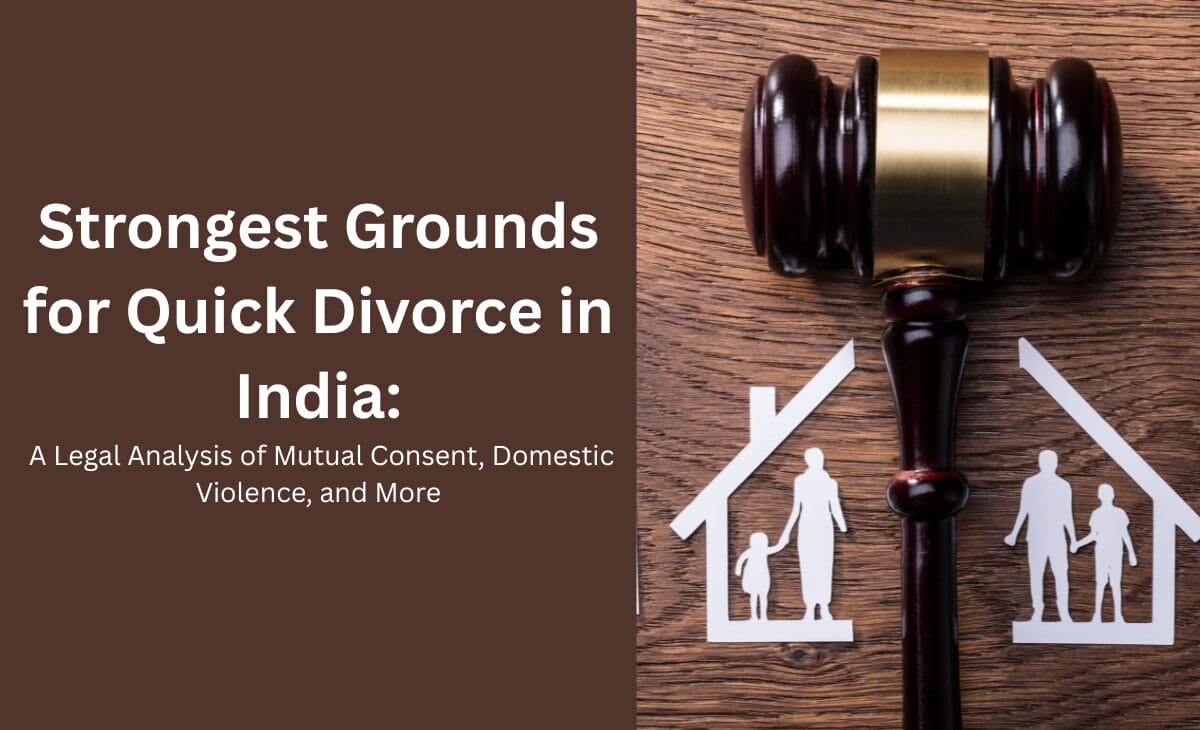
Strongest Grounds for Quick Divorce in India: A Legal Analysis of Mutual Consent, Domestic Violence, and More
Key Takeaways
- Under Section 13B of the Hindu Marriage Act, spouses must live separately for one year, file a joint petition, and observe a six-month cooling-off period (waivable) for mutual consent divorce.
- Under Section 13(1)(ia) HMA and the Protection of Women from Domestic Violence Act, 2005, divorces for cruelty can be expedited by submitting photographs, medical and police reports, and witness statements.
- Desertion under Section 13(1)(ib) HMA requires proof of voluntary, continuous two-year abandonment with intent not to return, evidenced by witness testimony and documentary records.
- Section 13B HMA recognizes incompatibility of temperament as an irretrievable breakdown ground, enabling mutual consent divorce within 6–18 months through joint petition and optional mediation.
- Section 13(1)(b) HMA allows divorce for irretrievable breakdown without fault evidence; spouses may file via online legal platforms, firms, or legal aid clinics with marriage certificate, ID, and address proof.
Getting a quick divorce in India is possible under certain conditions. Knowing the strongest legal grounds can make the process simpler.
In India, mutual consent is one of the quickest ways to get a divorce. Couples can file for divorce together, saving time and reducing stress.
Domestic violence can speed up divorce proceedings. Proving a history of abuse gives the court a solid reason to act quickly.
Incompatibility of temperament is increasingly seen as a valid ground. Younger couples often face this, and the courts understand the need for resolution.
Desertion is another strong reason for expediting a divorce. If one partner abandons the other, the deserted spouse can seek a faster legal process.
Lastly, resources for a quick divorce are available for those facing irretrievable breakdowns. These support networks can guide you through the legal steps involved.
In this post, we’ll dive deeper into each ground, helping you understand your options.
What Are the Legal Grounds for Filing a Quick Divorce in India Based on the Parties’ Mutual Consent?
The primary legal ground for filing a quick divorce in India based on mutual consent is found in Section 13B of the Hindu Marriage Act, 1955. This section allows couples to dissolve their marriage amicably without lengthy litigation, provided they both agree to the terms.
What Is the Process for Filing a Mutual Consent Divorce?
To file for a mutual consent divorce, both spouses need to follow specific steps:
- Filing of Petition: Both parties must jointly file a petition in the relevant family court.
- Affidavit Submission: Each party submits an affidavit confirming their consent to the divorce.
- Cooling-Off Period: There is typically a mandatory cooling-off period of six months. However, this can be waived in certain situations by the court.
- Second Motion: After the cooling-off period, both parties need to appear in court for a second motion.
- Final Order: The court will issue a divorce decree if satisfied with the proceedings.
This process is designed to minimize stress and expedite the divorce procedure for couples in agreement.
What Are the Key Requirements for Filing a Quick Divorce?
To qualify for a mutual consent divorce, certain conditions must be met:
- Both spouses must live separately for at least a year.
- They must willingly consent to the divorce without coercion.
- There should be no chance of reconciliation.
- They should have settled all financial and parental disputes.
Failure to meet any of these prerequisites can result in rejection by the court.
What Are the Advantages of Mutual Consent Divorce?
Choosing mutual consent divorce offers several benefits:
- Speed: The process is generally faster than contested divorces.
- Cost-Effective: Legal fees and court costs are usually lower.
- Confidentiality: The proceedings are private compared to contested cases.
- Flexibility: Couples have more control over the terms of the divorce.
Here is a comparison of mutual consent divorce and contested divorce:
| Aspect | Mutual Consent Divorce | Contested Divorce |
|---|---|---|
| Duration | Approx. 6 months | 1-5 years or more |
| Cost | Lower | Higher legal fees |
| Confidentiality | Private | Public proceedings |
| Control Over Terms | High | Limited |
What Happens If One Party Refuses Consent?
If one spouse refuses to consent, the other person can file for a contested divorce under applicable grounds, such as cruelty, adultery, or desertion. This process is more time-consuming and involves legal disputes that require thorough evidence.
What Is the Role of Mediation in Quick Divorces?
Mediation can play a vital role in facilitating mutual consent divorces. If parties are struggling to agree, a trained mediator can help them navigate issues like child custody and property division. Mediation encourages cooperation rather than conflict, making it easier to reach a resolution.
Need Legal Assistance?
Getting a quick divorce based on mutual consent can be straightforward with the right guidance. Consider consulting a lawyer who specializes in family law to navigate the process effectively. They can help you draft the petition, negotiate terms, and represent you in court.
FAQ
Can a mutual consent divorce be contested later?
Once finalized, a mutual consent divorce cannot be contested. However, specific terms like alimony or child custody can be revisited if agreed upon initially.
Is there a need for a lawyer in a mutual consent divorce?
While you can represent yourself, hiring a lawyer is advisable. They can help avoid mistakes and ensure all legal requirements are met.
What if there are children involved?
You must address child custody and support during the divorce. Both parties should mutually agree on these issues to facilitate a smoother process.
How Can a History of Domestic Violence Be Established as a Ground for Expedited Divorce Proceedings in Indian Courts?
Establishing a history of domestic violence can facilitate expedited divorce proceedings in Indian courts under the Protection of Women from Domestic Violence Act, 2005.
What is Domestic Violence Under Indian Law?
Domestic violence refers to any act, omission, or commission that harms a woman. It includes physical, emotional, economic, or sexual abuse. The law aims to protect women from any form of violence within a domestic setting. Under Section 3 of the Protection of Women from Domestic Violence Act, 2005, such acts are clearly defined and provide women with a legal scope to claim protection.
How Can Domestic Violence Be Proved in Court?
To file for a quick divorce based on domestic violence, the victim must present evidence. Evidence can include:
- Photographs of physical injuries
- Medical reports detailing injuries
- Witness statements from friends or relatives
- Police reports where domestic violence was reported
- Text messages, emails, or call recordings showing threats or abusive behavior
This evidence helps the court recognize the severity and frequency of violence, thus justifying expedited proceedings.
What is the Procedure for Filing a Quick Divorce Due to Domestic Violence?
The typical procedure includes:
- Filing a petition for divorce citing domestic violence.
- Providing relevant evidence to support the claims.
- Attending hearings where both parties present their side.
- Awaiting the court’s decision based on the evidence presented.
The presence of domestic violence can expedite the judicial process as it poses an immediate threat to safety, warranting swift action.
What Are the Legal Provisions for Quick Divorce in Cases of Domestic Violence?
The courts prioritize cases involving domestic violence, especially under certain provisions:
- Section 13(1)(ia) of the Hindu Marriage Act allows for divorce if a spouse has been treated with cruelty.
- Section 32 of the Domestic Violence Act enables immediate relief orders, including divorce.
These provisions highlight the urgency and seriousness with which Indian law treats domestic violence, paving the way for quicker divorce settlements.
Comparison of Divorce Grounds Related to Domestic Violence
| Grounds for Divorce | Legal Provisions | Timeframe for Proceedings |
|---|---|---|
| Domestic Violence | Protection of Women from Domestic Violence Act, 2005 | 6 months to 1 year |
| Cruelty | Section 13(1)(ia) Hindu Marriage Act | 1 year to 2 years |
| Mutual Consent | Section 13B Hindu Marriage Act | 6 months to 1 year |
What Are Some Key Points to Remember?
- Domestic violence is a serious offense, and the victim has the right to seek divorce.
- Legal evidence is crucial; collect as much as possible to support claims.
- Approach a lawyer familiar with domestic violence cases for guidance.
- Timely filing can lead to quicker resolution of the divorce.
Need Legal Assistance?
Getting help from the right legal expert can ensure that your case is handled efficiently. An experienced lawyer can guide you through the necessary steps, helping to protect your rights and interests.
Frequently Asked Questions
Can I file for divorce immediately after experiencing domestic violence?
Yes, you can file for divorce immediately. Document your experiences and seek legal help.
What if my partner denies the allegations of domestic violence?
The court will examine evidence presented by both parties. Solid evidence will support your case.
Are there any support services available for victims of domestic violence?
Yes, several organizations provide legal and emotional support for victims of domestic violence in India.
Why Is Incompatibility of Temperament Considered a Valid Ground for Quick Divorce Among Younger Couples in India?
Incompatibility of temperament is a valid and recognized ground for quick divorce among younger couples in India due to the increasing acceptance of the need for mental and emotional compatibility in marriages. When couples cannot align in their personalities, values, or lifestyles, it often leads to conflict and unhappiness, making separation the best option.
What Does Incompatibility of Temperament Mean?
Incompatibility of temperament refers to the clash between two individuals’ personalities, behaviors, or life goals. It implies a persistent mismatch, causing ongoing friction or dissatisfaction in a relationship. This mismatch can manifest in various ways, such as arguments over finances, parenting styles, or social activities. Younger couples often feel the pressure to be happy and fulfilled, leading them to seek divorce when compatibility issues arise.
Legal Provisions in India for Incompatibility as a Ground for Divorce
Section 13B of the Hindu Marriage Act, 1955 directly addresses mutual consent for divorce. Under this section, spouses can file for divorce if they agree that their marriage has irretrievably broken down due to incompatibility. It requires both parties to jointly submit a petition, making the process more straightforward and efficient.
Why Are Younger Couples More Likely to Use This Ground?
Younger couples today tend to prioritize personal happiness and emotional well-being. Here are some key reasons why incompatibility appeals to them:
- Cultural Shift: There is a growing acceptance of divorce as a valid option.
- Awareness: Increased social media and communication raise awareness of relationship dynamics.
- Independence: Younger generations value individual autonomy in relationships more than previous generations.
Process for Filing a Quick Divorce Based on Incompatibility
The process for filing a quick divorce on the ground of incompatibility typically involves the following steps:
- Consult a Lawyer: Seek legal advice to understand the implications.
- Mutual Consent: Both parties must agree on divorce terms.
- Draft a Petition: A legal petition must be drafted and filed with the family court.
- Attend Mediation: The court may require counseling or mediation to attempt reconciliation.
- Court Hearing: Attend court for a hearing to finalize the process.
Comparison of Incompatibility with Other Grounds for Divorce
| Grounds for Divorce | Incompatibility of Temperament | Desertion | Domestic Violence |
|---|---|---|---|
| Mutual Consent Required | Yes | No | No |
| Cooling-off Period (6 Months) | Yes | No | N/A |
| Need for Evidence | Low | Moderate | High |
| Emotional Distress | High | Moderate | High |
Concrete Examples of Incompatibility Leading to Divorce
Consider the following scenarios:
- Case 1: A couple marries young but soon realizes they have vastly different views on finances. One partner enjoys spending while the other prefers saving. This dissonance leads to frequent arguments and dissatisfaction.
- Case 2: Two individuals from different cultural backgrounds marry. While they may love each other, their views on family traditions and socializing might clash, causing stress and conflict.
How Common Is This Ground for Divorce?
Surveys show that a significant number of younger couples cite incompatibility as a reason for divorce. Statistics indicate that many divorces among those aged 25-35 involve issues of emotional support, lifestyle choices, and communication patterns. It highlights how shifting societal norms affect matrimonial choices.
Need Legal Assistance?
If you are considering divorce based on incompatibility, legal advice is crucial. A lawyer can guide you through your options and rights. Contact our firm to schedule a consultation.
Frequently Asked Questions
- Is incompatibility a valid legal ground for divorce?
Yes, incompatibility is recognized under Section 13B of the Hindu Marriage Act - .How long does the process take?
The process may take around 6-18 months, depending on court schedules and other factors.
Do both parties need to agree?
Yes, both parties must mutually consent to file for divorce based on incompatibility.
When Is Desertion Recognized as a Strong Ground for Accelerating Divorce Cases for Abandoned Spouses in India?
Desertion is recognized as a legitimate ground for expedited divorce in India when one spouse voluntarily abandons the other for a continuous period of two years without reasonable cause.
What Is Desertion in Legal Terms?
Desertion is when one spouse decides to leave the marital home with the intention of ending the marriage. The law considers it a serious issue when one partner walks out without justifiable reasons. According to Section 13(1)(ib) of the Hindu Marriage Act, 1955, desertion can form the basis for divorce if it lasts for over two years.
What Are the Key Elements of Desertion?
To establish desertion legally, the following elements must be proven:
- Voluntary Act: The spouse must have left the marital home of their own free will.
- Intent to Separate: There should be a clear intention not to return.
- Continuous Abandonment: The spouse must have been absent for at least two years.
- No Just Cause: The deserted spouse should not have given valid reasons for the other’s departure.
Each of these points is crucial when filing for divorce based on desertion.
What Are the Steps Involved in Filing for Divorce Due to Desertion?
Here are the steps to follow:
- Gather Evidence: Collect proof of desertion, like witness statements and documents.
- File a Petition: Submit a divorce petition at the family court.
- Serve Notice: Inform the other spouse officially about the case.
- Attend Hearing: Participate in court hearings as scheduled.
- Present Your Case: Provide evidence and testimony to support your claim of desertion.
This process can vary slightly based on local court rules.
| Step | Details |
|---|---|
| 1. Gather Evidence | Collect documents proving absence and intent. |
| 2. File Petition | File your case in the relevant family court. |
| 3. Serve Notice | Notify the other spouse about the proceedings. |
| 4. Attend Hearing | Be present at scheduled court dates. |
| 5. Present Case | Support your claim with evidence and arguments. |
How Does Desertion Compare to Other Grounds for Divorce?
Desertion is often compared to other grounds such as cruelty or mutual consent. Here’s a simple comparison:
| Ground for Divorce | Timeframe | Burden of Proof |
|---|---|---|
| Desertion | Two years continuous | Proof of abandonment and intent |
| Cruelty | Varies, no specific period | Evidence of mistreatment |
| Mutual Consent | Six months from filing | No burden, both agree |
What Are the Common Misconceptions About Desertion?
Some common misconceptions include:
- Misunderstanding of Intent: Many think that just leaving is enough, but intent to separate is crucial.
- Duration Miscalculation: Sometimes, people forget that the two-year requirement is essential.
Understanding these misconceptions can help spouses tailor their approach correctly.
Need Legal Assistance?
If you find yourself in this situation, seeking legal guidance is important. Understanding the complexities of desertion can be challenging. Our law firm can help simplify the process and ensure you have the best chance of success.
Frequently Asked Questions
1. Can I file for divorce immediately after a spouse leaves?
No, you generally need to wait at least two years to prove desertion.
2. Is counseling required before filing for divorce based on desertion?
Counseling is not mandatory, but it’s often recommended to explore reconciliation options.
3. Will filing for divorce due to desertion affect alimony or child custody?
It can. Courts consider circumstances of the desertion when deciding on alimony and custody issues.
Consulting a lawyer can provide clarity on these matters.
Where Can You Access Legal Resources or Support for Obtaining a Quick Divorce on the Grounds of Irretrievable Breakdown of Marriage in India?
You can access legal resources and support for obtaining a quick divorce due to irretrievable breakdown of marriage through various channels, including online legal services, local law firms, and legal aid clinics.
What Are the Legal Provisions for Irretrievable Breakdown of Marriage?
The grounds for irretrievable breakdown of marriage are recognized under Indian law. Section 13(1)(b) of the Hindu Marriage Act, 1955 allows a spouse to file for divorce based on the fact that the marriage has “broken down irretrievably.” This provision is significant as it does not require proof of cruelty, desertion, or any other fault.
Where Can You Find Online Legal Services?
Online legal services can streamline the divorce process. Websites typically offer legal advice and assistance in filing petitions. Here are common options:
- Legal consultation platforms
- Law firm websites with dedicated divorce sections
- Mobile apps focused on legal services
These platforms often provide templates and guidance for drafting necessary documents, which simplifies the legal process.
How to Access Local Law Firms?
Local law firms can provide personalized assistance. You can find law firms through these methods:
- Online directories of lawyers
- Referrals from friends or family who have undergone divorce
- Visiting local bar associations
Choosing a local firm ensures you receive support based on regional laws and practices.
What Are the Benefits of Legal Aid Clinics?
Legal aid clinics are a valuable resource for obtaining affordable or free legal assistance. They are usually linked to universities or non-profit organizations. Benefits include:
- Access to trained legal professionals
- Support for low-income individuals
- Workshops to help you understand the divorce process
These clinics help those who may not afford legal fees get the assistance they need.
What Steps Should You Follow to File for Quick Divorce?
Filing for a quick divorce involves some straightforward steps:
- Consult with a lawyer to understand your options.
- Gather necessary documents, such as the marriage certificate and ID proof.
- Draft and file the mutual consent petition.
- Attend court hearings as required.
)p>Clear organization of documentation speeds up the process.
Comparison of Divorce Support Options
| Support Type | Cost | Personalization | Ease of Access |
|---|---|---|---|
| Online Legal Services | Varies; typically lower | Standard templates | Very easy |
| Local Law Firms | Higher | Highly personalized | Moderate |
| Legal Aid Clinics | Free or low-cost | Moderate personalization | Easy |
Need Legal Assistance?
If you seek guidance, contacting a law firm directly is a good choice. Personal discussions can clarify rights and options, improving your chances for a favorable outcome.
Mini FAQ
Can I file for quick divorce without a lawyer?
Yes, but having a lawyer can help ensure all legal requirements are met.
What documents are needed to file for divorce?
You typically need your marriage certificate, ID proof, and address proof.
How long does the divorce process take?
The process can take as little as six months if both parties agree.
Conclusion
Understanding your grounds for a quick divorce can streamline your legal journey.
First, consider consulting with a family law attorney to guide you through the process. They can clarify the best route based on your situation.
Next, gather important documents like your marriage certificate and identification. Having these ready will speed up your filing.
Remember, mutual consent, domestic violence, incompatibility, and desertion are strong legal grounds for divorce in India. Each has specific procedures and requirements, which can affect how quickly you can obtain a divorce.
With my expertise, I can help you navigate these legal waters effectively. Don’t hesitate to reach out for assistance tailored to your needs.

Pratham is a legal information researcher and content creator dedicated to making Indian law accessible to everyone. With expertise in legal research and content development, Pratham creates detailed, well-researched articles on Indian laws to help readers understand complex legal concepts in simple language. All content is thoroughly researched from authentic legal sources including Indian statutes, court precedents, government publications, and established legal databases. Each article is fact-checked and updated regularly to reflect current laws and amendments.