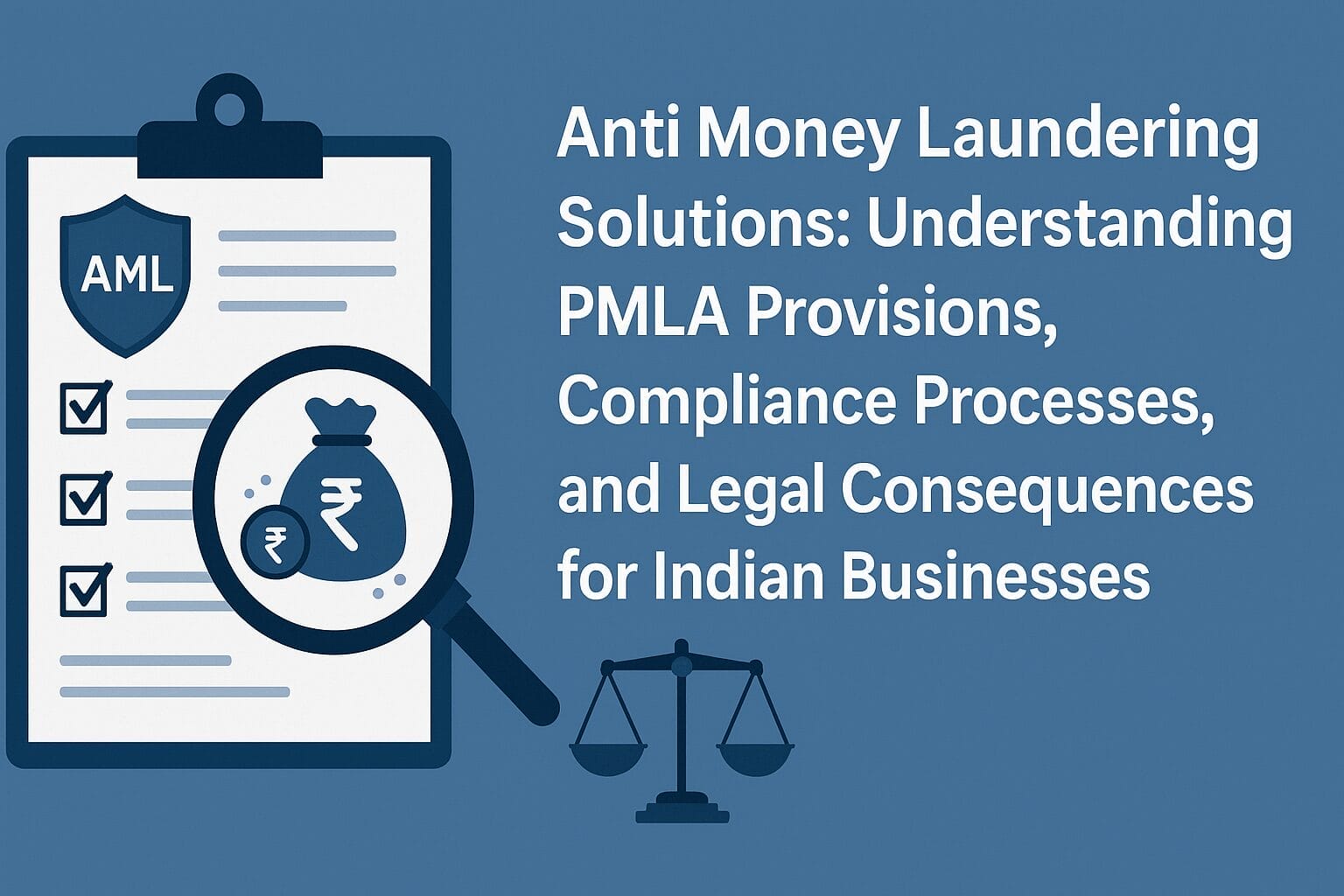
Anti Money Laundering Solutions: Understanding PMLA Provisions, Compliance Processes, and Legal Consequences for Indian Businesses

Key Takeaways
- PMLA mandates customer due diligence procedures—collecting valid Aadhaar or PAN details and ongoing transaction monitoring based on risk profiling under Sections 12 and 13.
- Indian businesses must retain customer identification, transaction records and Suspicious Activity Reports (SARs) for a minimum of five years as per PMLA requirements.
- Upon detecting suspicious transactions, entities must file a Suspicious Activity Report (SAR) to the FIU-IND via the designated online portal without alerting the customer.
- Non-compliance with PMLA can lead to fines from INR 5 lakh to INR 2 crore, imprisonment for three to seven years, and forfeiture of laundered assets under Sections 3 and 4.
- Companies are required to conduct comprehensive internal AML audits at least annually—or following events like management changes, regulatory updates or spikes in SARs—to ensure PMLA compliance.
Understanding the Prevention of Money Laundering Act (PMLA) is essential for any business in India. Compliance with PMLA can save companies from serious legal troubles and penalties.
The law includes key provisions that every business should know. By implementing effective anti-money laundering processes, companies can mitigate risks and stay compliant.
Non-compliance consequences under PMLA have become increasingly severe. Financial institutions and corporates face heavy fines and reputational damage.
Regular internal audits of anti-money laundering practices are crucial to ensuring compliance. These audits help businesses identify problems before they escalate.
Moreover, knowing the regulatory authorities responsible for enforcing these laws is essential. Building a good relationship with these agencies can be beneficial for businesses.
In this post, we’ll break down the key elements of PMLA and how businesses can successfully navigate these legal waters.
What Are the Key Provisions of the Prevention of Money Laundering Act (PMLA) That Every Business Should Know to Stay Compliant?
The Prevention of Money Laundering Act (PMLA) mandates that all businesses implement measures to prevent money laundering. Key provisions include customer due diligence, maintenance of records, and reporting suspicious activities.
What Is Customer Due Diligence (CDD) Under PMLA?
Customer due diligence is a critical part of PMLA. Businesses must verify the identity of customers and assess their financial activities. This includes collecting documents like Aadhaar, PAN cards, or company registration details.
- Know your customer (KYC) requirements.
- Continuous monitoring of customer transactions.
- Assess the risk of money laundering based on the customer’s profile.
What Are the Record-Keeping Requirements?
All businesses must maintain records of transactions for at least five years. This applies to both financial transactions and customer identification documents. Keeping accurate records helps in monitoring and compliance.
| Type of Record | Duration of Retention |
|---|---|
| Customer Identification Documents | 5 years |
| Transaction Records | 5 years |
| Suspicious Activity Reports | 5 years |
How Should Businesses Report Suspicious Activities?
PMLA requires businesses to report any suspicion of money laundering to the Financial Intelligence Unit (FIU). The report should include relevant details without alerting the suspected individual.
Steps to File a Suspicious Activity Report (SAR):
- Gather all available information about the transaction.
- Document your reasons for suspicion.
- Submit the SAR through the designated online portal.
What Are the Penalties for Non-Compliance?
Non-compliance with PMLA can lead to severe penalties. Fines can be substantial, and business licenses may be suspended or revoked. This highlights the importance of staying informed and compliant.
- Fines up to INR 5 lakh.
- Imprisonment for up to seven years for serious offenses.
What Are Some Industry-Specific Requirements?
Different industries may have unique requirements under PMLA. Financial institutions often face stricter scrutiny compared to non-financial businesses. Understanding these variances helps in compliance.
For example, banks must have comprehensive anti-money laundering programs, while real estate or casinos may need simpler protocols. Awareness ensures tailored compliance.
Need Legal Assistance?
If you want to ensure your business follows PMLA, consult our experienced legal team. We can assist in implementing effective compliance measures tailored to your business needs.
Frequently Asked Questions
What is the primary goal of PMLA?
The primary goal of PMLA is to prevent money laundering and ensure that businesses do not inadvertently facilitate illegal activities.
Who should be responsible for compliance in a company?
The compliance officer is generally responsible, but all employees should be trained in recognizing and reporting suspicious activities.
How often should businesses review their anti-money laundering policies?
Businesses should review their anti-money laundering policies annually or whenever they encounter significant changes in operations or regulations.
How Can Indian Businesses Implement Effective Anti-Money Laundering Processes to Mitigate Risks and Compliance Issues?
Indian businesses can implement effective anti-money laundering processes by establishing robust internal controls, conducting training, and ensuring timely reporting to regulatory bodies.
What Internal Controls Should Be Established?
Establishing internal controls is crucial for mitigating money laundering risks. Companies should develop clear policies outlining the procedures for customer due diligence, transaction monitoring, and reporting suspicious activities.
- Conduct risk assessments to understand potential money laundering vulnerabilities.
- Implement Know Your Customer (KYC) guidelines for verifying customer identities.
- Set transaction limits and monitor unusual patterns.
- Maintain thorough documentation of all financial transactions.
How Important Is Employee Training?
Employee training is essential for fostering a culture of compliance. Employees must understand the legal requirements under the Prevention of Money Laundering Act (PMLA) and the specific risks related to their roles.
- Regularly conduct training sessions on AML laws and organizational policies.
- Use case studies to highlight real-life money laundering scenarios.
- Evaluate employees’ understanding through assessments.
What Reporting Procedures Should Be Followed?
Effective reporting mechanisms facilitate prompt action against suspicious activities. It is vital to set clear procedures for reporting such cases to the Financial Intelligence Unit-India (FIU-IND) or other relevant authorities.
| Reporting Level | Frequency | Details |
|---|---|---|
| Internal Reports | Daily | Monitor transactions and flag anomalies. |
| SARs (Suspicious Activity Reports) | As required | Report any suspicious activities to FIU-IND. |
| Annual Compliance Audits | Yearly | Review and update AML policies. |
What Role Does Technology Play?
Technology is an essential part of implementing AML processes. Companies can use software solutions to automate transaction monitoring and reporting.
- Invest in AML software to analyze transaction patterns.
- Utilize secure platforms for storing customer data.
- Monitor regulatory updates through automated alerts.
What Are Common Challenges Businesses Face?
While implementing AML practices, businesses often encounter several challenges, including inadequate resources and lack of management support.
- Limited budgets for training and technology.
- Employee resistance to new policies.
- Complex regulatory requirements that are difficult to navigate.
Need Legal Assistance?
For businesses needing guidance in implementing effective AML processes, consulting legal experts can provide clarity and support. We offer specialized legal services to assist in compliance with PMLA regulations and establish effective controls.
FAQs
What are the penalties for non-compliance with PMLA?
Penalties include fines up to ₹5 lakh and imprisonment for up to 3 years.
How often should a business review its AML policies?
Businesses should review their AML policies at least annually or whenever significant changes occur.
Can small businesses implement AML processes?
Yes, small businesses can adopt simplified AML processes suitable for their size and risk profile.
Why Are Non-Compliance Consequences Under PMLA Increasingly Significant for Financial Institutions and Corporates in India?
Non-compliance with the Prevention of Money Laundering Act (PMLA) can lead to severe penalties for financial institutions and corporates in India. The implications range from hefty fines to criminal charges, loss of business licenses, and reputational damage.
What Are the Key Penalties Under the PMLA?
The PMLA has specific penalties for non-compliance, which include:
- Fines ranging from INR 5 lakh to INR 2 crore.
- Imprisonment for a term of three to seven years.
- Forfeiture of any property involved in money laundering.
The severity of these penalties illustrates how critical compliance is for businesses operating in India.
How Has the Enforcement Environment Changed?
Since the amendment in 2019, the enforcement of PMLA has intensified significantly. The number of investigations and prosecutions under this law has increased, particularly against high-profile cases in sectors like banking and finance.
Regulatory bodies like the Enforcement Directorate (ED) and the Financial Intelligence Unit (FIU) now have greater powers to investigate and enforce compliance. They can act independently and swiftly, which has changed the compliance landscape dramatically.
How Do Reputational Risks Factor In?
The reputational damage from non-compliance can be devastating. A company found guilty under the PMLA may face:
- Loss of customer trust.
- Negative media attention.
- Decline in stock prices for publicly traded companies.
Maintaining a strong compliance culture can help prevent these scenarios from unfolding. Companies must proactively engage in anti-money laundering practices to protect their reputation.
What Examples Highlight Significant Consequences?
Several financial institutions in India have faced severe penalties for non-compliance with the PMLA. In 2020, a prominent private bank was fined INR 10 crore by the RBI for failing to report suspicious transactions. The fine not only hurt their finances but also affected their reputation and customer base.
What Should Companies Do to Mitigate Risks?
To avoid these consequences, financial institutions and corporates should:
- Establish a comprehensive anti-money laundering compliance program.
- Conduct regular training for employees on PMLA requirements.
- Engage in periodic audits to assess compliance.
- Implement customer due diligence and risk assessment procedures.
- Stay updated on changes to the law and regulatory expectations.
Comparison of Penalties and Consequences
| Violation Type | Potential Penalty | Reputational Impact |
|---|---|---|
| Failure to Report Suspicious Transactions | INR 5 lakh – 2 crore fine | High risk of loss of customer trust |
| Non-Compliance Training | Imprisonment of 3 – 7 years | Severe negative media attention |
| Inadequate Record-Keeping | Forfeiture of involved assets | Long-term brand damage |
Need Legal Assistance?
If your business needs guidance on maintaining compliance with the PMLA, consider consulting legal experts. Our firm specializes in financial regulations and can provide tailored solutions to mitigate risks and enhance compliance strategy.
FAQ
What happens to businesses that repeatedly violate PMLA?
Repeated violations can lead to escalated fines, operating bans, and criminal charges against responsible individuals.
Can individuals face penalties under the PMLA?
Yes, senior management and board members can be held personally accountable for non-compliance.
Are small businesses at risk under PMLA?
Yes, small businesses are not exempt and must follow the same compliance standards as larger firms.
When Should Companies Conduct Internal Audits of Their Anti-Money Laundering Practices to Ensure Compliance with PMLA Regulations?
Companies should conduct internal audits of their anti-money laundering (AML) practices at least annually, or whenever there are significant changes to their business operations or AML regulations.
Why Are Regular Audits Important?
Regular audits help identify weaknesses in AML systems and processes. This is critical for compliance under the Prevention of Money Laundering Act (PMLA). Ignoring these audits can lead to legal penalties.
Deficiencies found during audits can be addressed proactively. This ensures companies remain compliant with the PMLA, while also protecting their reputation.
What Triggers a Need for Immediate Audits?
Certain events should prompt companies to conduct immediate audits. Some of these triggers include:
- Changes in management or ownership
- New types of business transactions
- Regulatory changes or updates from authorities
- Increased suspicious activity reports (SARs)
- Implementation of new technology or systems
What Are the Key Steps in Conducting an Audit?
It is essential to follow a structured approach for effective audits. Here are the key steps:
- Set clear objectives for the audit.
- Review the AML policies and procedures.
- Evaluate the training provided to employees.
- Check transaction records for anomalies.
- Interview staff to assess awareness of AML responsibilities.
- Document findings and suggest improvements.
What to Expect from an Audit Process?
During an audit, companies should anticipate the following:
| Audit Activity | Description | Timeline |
|---|---|---|
| Planning | Define scope and objectives | 1 week |
| Fieldwork | Collect data, review documents | 2-3 weeks |
| Reporting | Compile findings and recommendations | 1 week |
| Follow-up | Review implementation of suggestions | Ongoing |
Examples of Audit Findings
Audits have revealed various issues in companies. Here are a few illustrative examples:
- A bank discovered missing customer verification documents.
- A real estate firm failed to report suspicious large cash transactions.
- A retail chain did not provide adequate training on AML laws for its staff.
What Are the Consequences of Skipping Audits?
Skipping internal audits can lead to serious fallout:
- Legal penalties under the PMLA.
- Loss of business reputation.
- Potential criminal liability for management.
Need Legal Assistance?
If your company needs help with AML compliance or wants to conduct an internal audit, consider consulting with legal experts. Proper guidance can make all the difference in navigating PMLA regulations successfully.
FAQs
- How often should internal audits be conducted? At least once a year or when significant changes occur.
- What if irregularities are found during the audit? Companies should immediately act to address these issues and consult legal counsel.
- Can third-party firms conduct these audits? Yes, many companies hire external auditors for an unbiased review.
Who Are the Regulatory Authorities in India Responsible for Enforcing Anti-Money Laundering Laws and How Can Businesses Interact with Them?
The primary authorities enforcing anti-money laundering laws in India are the Financial Intelligence Unit (FIU), the Reserve Bank of India (RBI), and the Securities and Exchange Board of India (SEBI). Businesses need to engage proactively with these agencies to ensure compliance and address any potential issues.
What is the Role of the Financial Intelligence Unit (FIU)?
The FIU is the central anti-money laundering agency in India. It collects, analyzes, and disseminates financial intelligence. The unit investigates suspicious transaction reports (STRs) and coordinates with other law enforcement agencies. Businesses must file STRs whenever they notice any transaction that seems suspicious.
How Does the Reserve Bank of India (RBI) Contribute to AML Compliance?
The RBI supervises banks and non-banking financial companies (NBFCs) to ensure compliance with the Prevention of Money Laundering Act (PMLA). It issues guidelines, monitors transactions, and enforces regulations. Banks must follow the RBI’s comprehensive framework to prevent money laundering. Regular training and strict internal policies are essential for compliance.
What is the Securities and Exchange Board of India (SEBI) Responsible For?
SEBI oversees the securities market, ensuring that market participants comply with anti-money laundering laws. It mandates that registered entities follow strict reporting requirements and conduct due diligence. SEBI’s regulations require listed companies to maintain high standards of transparency and integrity.
How Can Businesses Effectively Interact with Regulatory Bodies?
Businesses can foster positive relations with regulatory authorities through various actions:
- Regularly submit all required reports, including suspicious transaction reports.
- Participate in training sessions and workshops on AML regulations.
- Request clarification on specific regulations or guidelines if needed.
- Engage with the FIU and other authorities during audits or inspections.
- Establish an open line of communication for ongoing compliance matters.
What Are the Key Regulations to Follow?
Some critical regulations that businesses must comply with include:
- Mandatory customer identification procedures (Know Your Customer – KYC).
- Regular monitoring of transactions to detect anomalies.
- Prompt reporting of suspicious activities as outlined by the PMLA.
- Implementation of internal policies and training programs for employees.
Comparison of Regulatory Authorities and Their Functions
| Authority | Primary Function | Key Regulations |
|---|---|---|
| Financial Intelligence Unit (FIU) | Collects and analyzes financial data | Monitoring STRs, reporting |
| Reserve Bank of India (RBI) | Supervises banking and NBFC operations | KYC, transaction monitoring |
| Securities and Exchange Board of India (SEBI) | Regulates securities market | Anti-fraud rules, reporting requirements |
Need Legal Assistance?
For businesses seeking guidance, consulting with experts on compliance is recommended. Regular updates and legal checks can save organizations from penalties. We assist firms in navigating complex AML laws and ensure they remain compliant with PMLA.
Mini FAQ
What should I do if I suspect money laundering within my business?
File a Suspicious Transaction Report (STR) immediately with the FIU and coordinate with your compliance team for further actions.
Can businesses face penalties for non-compliance with AML regulations?
Yes, non-compliance can lead to hefty fines, penalties, and other legal consequences.
How often should businesses update their AML policies?
It is advisable to review and update AML policies annually or whenever there is a change in regulations.
Conclusion
Businesses must comply with PMLA to avoid severe legal penalties and reputational damage.
Take immediate action by reviewing your anti-money laundering policies today.
Consider conducting a thorough internal audit to ensure compliance.
Finally, consult a legal expert to address any uncertainties regarding PMLA regulations.
Understanding PMLA is essential for all businesses in India. Key provisions include customer due diligence, record-keeping, and reporting suspicious activities.
Businesses should be aware of potential severe penalties for non-compliance, including hefty fines and imprisonment.
Engaging with regulatory authorities like FIU, RBI, and SEBI is crucial for proactive compliance.
I am here to help guide you through these complex regulations and support your business needs.


Pratham is a legal information researcher and content creator dedicated to making Indian law accessible to everyone. With expertise in legal research and content development, Pratham creates detailed, well-researched articles on Indian laws to help readers understand complex legal concepts in simple language. All content is thoroughly researched from authentic legal sources including Indian statutes, court precedents, government publications, and established legal databases. Each article is fact-checked and updated regularly to reflect current laws and amendments.